Q & A with Hank Torbert

HOME / Q & A with Hank Torbert

January 29th, 2013

Q: Over your career you have done some very interesting things – could you walk us through your career to date?

I have spent the last 15 years in the private equity, operational management,business development and corporate finance world after starting my career as an intern at the FifthThird Bank at fourteen.  After college, I helped build an emerging markets investment firm, and then went to business school at Columbia.  Post-graduate school, I was fortunate enough to join JPMorgan’s investment banking group.  This was an amazing experience in terms of exposure, training and career validation. After being promoted to Vice President, I left JPMorgan to become the COO of a client’s private equity firm in Washington, DC.  And, in 2006, founded my own investment firm to continue my focus on medium-sized companies.  Through my firm, I have been fortunate to have helped build two publicly-traded companies in the technology sector.

Q: Of all the stops along the way for you so far – which one/ones were the most gratifying?.

One of the most gratifying moments in my career was the 2008 initial public offering of Mood Media (TSX: “MM”), formerly Fluid Music, Inc.  an internet-based music services company.  I invested in the company and worked with the company’s founder from concept to the public offering.  To participate in the evolution of a company from birth was an amazing experience.

Q:  Who was a key mentor to you in your career and how did that relationship help you along the way?

I have been fortunate to have several mentors throughout my career.  One in particular was the late Mr. Clement Buenger, former Chairman of Fifth ThirdBank.  Mr. Buenger played an integral role in early career development as an intern at the Bank and ultimately my hiring at JPMorgan.  The most important lesson I learned from him was that, “you are too young to make a mistake.”   Specifically, don’t be afraid to test yourself, to try new things, or to pursue your dreams.  In addition, he constantly reminded me of my personal obligation to always assist others in need, especially as it related to advancement of education and the arts.

Q: Along the way you have personally done great things breaking through diversity barriers – what advice would you have today for any minorities aspiring to a business career in sports?

Pursuing any career path has its challenges. But the most important thing to remember is that you should never let anyone take away or diminish how hard you have worked to get to where you are.  Also, be inquisitive.  Try to meet those who are where you would like to go with your career and get their insight.  You will be surprised at how much people are willing to share their experiences with you – especially in the sports business industry.  This knowledge will assist you in plotting a career course for yourself.

Q: You have some interesting ties to Professional Baseball – could you tell us about those?

I have been very fortunate to have met and known two owners of MLB teams for several years. Through these relationships, I have gained a lot of insight into the business side of major league baseball and other franchises.

Q: Over your career you have worked in both the Corporate and  Entrepreneurial Sectors -which have you enjoyed more?

I have most enjoyed entrepreneurial sectors and experiences.  I have always considered myself a builder or one who likes to assist others in building platforms.  This is no different than building a home, you have the ability to step back and say, “I have created something.”

Q: What are a couple of your favorite sports moment as a fan?

In many ways, the sport heroes of childhood represented tenacity, dedication and all the other positive values of great athletes.  As a result, my most memorable sports moments include:

1) Hank Aaron hitting his career home run number 715 on April 8, 1974, breaking Babe Ruth’s record. I am actually named after Hank Aaron.

2) The Big Red Machine dominating the National League from 1972 – 1976. As a young child, Cincinnati Reds games were always playing in the background on the radio or the television.

Q: What are your favorite activities outside of work?

Fishing by far. My father first took me fishing when I was a young boy, and I have loved it ever since.  If I’m not around, I’m probably fishing somewhere away from it all.
 

In Memory of Stan…

HOME / In Memory of Stan…

January 23rd, 2013

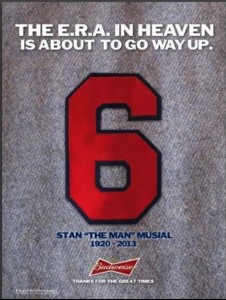
Rest in peace, Stan Musial.  Simple words, and ones we get the unfortunate chance to use more and more often as we too age, but even in their simple beauty the words cannot express the feelings.

Part of St. Louis died on January 19, 2013.  Part of the game of baseball left us as well.  It’s easy to use hyperbole to overstate the memory and the place in history of nearly anyone who has recently passed, but it’s my heartfelt feeling that such overblown statements about Stan “The Man” do not exist.  At his retirement, after 22 years with the Cardinals, baseball commissioner Ford Frick described No. 6 as “Baseball’s perfect warrior. Baseball’s perfect knight.”  Say that about anyone else and people will roll their eyes.

The fine folks at Budweiser got it right...
The fine folks at Budweiser got it right…

Stan and the Cardinals.  Stan and Cardinal fans.  They are as intertwined and linked as the hydrogen and oxygen in the water we drink. They are as inseparable as identical twins.  They are the perfect match.

The St. Louis Cardinals are one of baseball’s greatest franchises, but they are more than that. They are not flashy. They don’t outspend their opponents to buy championships. They are not lovable losers, nor are they arrogant winners. They have exuded class and professionalism over the span of roughly 120 years.  Their fans are fervent without being brash or petty. They are not fair weather backers, who slink away and forget their team when times are tough. They know the game, and they appreciate the smallest details. They are such great and intelligent supporters that they themselves are a strong selling point when any free agent is considering a move to St. Louis.

And those players stay. They come from far and wide, all around the world, and an uncanny number of them never leave, staying attached and connected to the community that has become a part of them, just as they have become a part of the city.

Stan Musial was all of that, and more. If described accurately in a novel, any reader would have to think his character was fictitious. He was clearly one of the greatest players to ever take the field, but his humility and demeanor, his class and dignity, and his affable personality might have actually provided a bit of cover for his true statistical greatness.  His career batting average was .331, he clubbed 475 home runs, drove in 1,951 runners, and amazingly  struck out only 696 times over the course of 12,717 plate appearances.  He is in the Hall of Fame, and there was never a doubt.  And yet, we refer to him as a kind and gentle person, a fun-loving boy in a man’s body, a great friend and a brilliant teammate.  Babe Ruth?  714 home runs.  Ty Cobb?  4,189 hits.  Joe DiMaggio? 56 consecutive games with at least one hit.  Stan Musial?  A great man.  He is unique in that regard, to have been a certifiable superstar of the highest caliber and yet still be known more for the man he was, rather than the player.

Anyone who watched him play and could see his grace knew all of this.  I hardly feel worthy to add my perspective to the overwhelming deluge of brilliantly written obituaries and odes to the man, all of which we’ll have the joy to read so emotionally over the next few days.  But I also feel compelled to share all of this because Stan was more than all of this to my father and to the Wilber family.  He was a friend.  A loyal, happy, supportive friend.  Despite the fact I am the youngest of the Wilber clan, and was only seven when Stan retired in 1963, I knew him and I knew he was special.

Big Del Wilber came up to the big leagues after World War II, making his first appearance as a Cardinal in 1946.  Like so many others before and after, Dad went on to play for other teams and work for other organizations, but he (and we) remained St. Louisans.  There are millions of reasons why I thank my parents for giving me the pure good fortune to be their child, but the decision to put down roots in the Gateway City is near the top of the list.

Those Cardinals were a close bunch, and my childhood was filled with visits to the Musial’s home, Marty Marion’s home, and Ruggeri’s restaurant on The Hill, where Joe Garagiola could often be found while his brother Mickey manned the door as the host and maitre d.  Holiday parties were baseball and media bashes in the Wilber house, as well.  Growing up knowing that any phone call, or any knock on the door, could have just as likely been initiated by a ballplayer or newscaster as it was by a neighbor was something we all got used to by the time we could walk.

The perfect Boy Scout

Stan came to Wilber weddings, he stayed in touch, and his lovely wife Lillian remained a dear ally and friend of our mother Taffy for life.  The Musials felt more like neighbors, or family members.  With nary a shred of self-importance, Stan never seemed like a celebrity to us. He could just as well have been an uncle, and if so he would’ve been our favorite uncle.

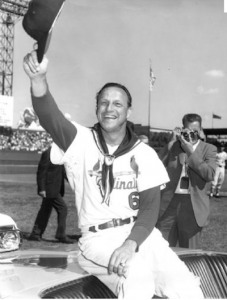
When Stan retired in 1963, his final day in uniform was marked by a pre-game ceremony and during the fete he wore a Boy Scout neckerchief.  It was a little silly looking, actually, but he never would’ve thought to take it off and he wore it proudly. He was, after all, a perfect Boy Scout.  He was self-effacing to the point of sheer humility.  For all of his athletic greatness, his grace and sincerity were his greatest attributes.

His favorite musical instrument was the harmonica, and he was rarely (if ever) without one. A harmonica. The most modest of all instruments, and one that can hardly be played without it sounding more like “fun” rather than music.  Perfect.

We’ve lost a truly great one, but we had him for 92 years and it was his time to go.  Now, he joins Del Wilber, Taffy Wilber, Lil Musial, and so many of their dearest friends in the great beyond.

Rest in peace, Stan Musial.  You were, are, and always will be “The Man”.

Q & A with David Bell

HOME / Q & A with David Bell

October 10th, 2012

As member of the prestigious Advertising Hall of Fame, David Bell has over 40 years of experience in the marketing communications sector. He is Chairman Emeritus and previously served as Chairman and CEO of The Interpublic Group, Inc., one of the world’s largest marketing communications service companies.

Mr. Bell previously held the positions of Chairman and CEO of True North Communications Inc., the world’s sixth largest global advertising and marketing communications holding company. Mr. Bell was also President and CEO of Bozell Worldwide, where he helped grow the agency from $12 million to over $500 million in revenues; and prior to that was President of Knox Reeves Advertising, which was acquired by Bozell.

In his career, he has served virtually every kind of industry, from automotive to financial services; consumer packaged goods as well as business-to-business. Mr. Bell serves the industry as Past Chairman of The Advertising Council, The American Advertising Federation, The Advertising Educational Foundation and The American Association of Advertising Agencies. Mr. Bell was inducted into the Advertising Hall of Fame by his peers in March 2007.

Q: What was your first job?

Fresh out of college I was hired by Leo Burnett in Chicago to work in their Training Program. I was the only non-MBA out of 19 people in the program and that  job saved me from going to Law School  

Q:  Of all the jobs you have had were there any that were particularly rewarding/fulfilling – and why?

Yes! My current job of ‘Coach’ – today I am mentoring dozens of young people along with companies like Gyro, Creative Realities and AOL.

Q:  You have mentored a lot of young people – did you have a mentor when you were growing up?

Several but two stand out – Chuck Pihl became a mentor of mine when I was 14 and I will never forget him.

Chuck Peebler, who was the CEO at Bozell Worldwide when I was the President  was my partner, collaborator, friend and mentor for 25 years.

Both men contributed greatly to my business and personal growth.

Q: You know as much about sports media and sponsorships as anyone on the planet — what are the trends you see these days?

Activation and Lower Costs for sure.

These two elements can dramatically drive more efficiency and  higher ROI

Q: You have a World Class family – how have you been able to balance your career with family?

I always schedule family first and business second – and – I always try to remember that ‘one surprise is worth 10 expecteds’

Q: You are a big NY Yankees  fan – who is your favorite Yankees manager of all time?

Joe Torre – he had a unique and invaluable skill of being able to push different buttons with different players to help them raise their game

Q: Do you have a favorite sports memory?

Yes! As an original bond and season ticket holder with the Minnesota Vikings I have vivid and fond memories of the Bud Grant Super Bowl teams during the 70’s.

I also am totally enjoying the amazing resurgence of  Washington Nationals and Baltimore Orioles this season


Q & A with Sara Loarte

HOME / Q & A with Sara Loarte

June 12th, 2012

We recently asked Sara Loarte about her interests, and the business of baseball. We know you’ll really enjoy reading her story:

Q: Over your career you have done some very interesting things and worked on some very exciting projects  — which one of those was the most rewarding and why? 

In 2001 I was fortunate to work on the MLB Opening Day Series in San Juan, Puerto Rico between the Texas Rangers and the Toronto Blue Jays.  The Series was the first regular season game ever played in Puerto Rico, however the reason the Series has meant so much to me is because I was born in Puerto Rico and I participated in the island’s sports history.  The enthusiasm and energy that the Major League teams received from the locals were contagious.  Even the players felt it was something special.  Carlos Delgado (1st baseman for the Blue Jays) and Ivan Rodriguez (catcher for the Rangers) who are both natives of Puerto Rico were quoted as saying that it was the most important game they have ever played in their careers.  This will always be an event that I cherish for years to come.

Q:  Who was a key mentor to you in your career and how did that relationship help you along the way?

My key mentor during the early stages of my sports marketing career was Steve Baker, former President of the NAIA. Steve and I both worked together for a few years in the international division of Major League Baseball.  His insights on marketing have always been very  progressive but the most impactful advise he provided was that you should always focus on your strengths and to be a big fish in a little pond… During the latter part of my career, Tim Brosnan, the head of MLB business, was instrumental in opening doors for me to grow professionally at the League.  Tim’s business and legal influence have helped me become more disciplined about my business performance.  He always reinforced that a good deal had to be one that was “good for both sides” otherwise it would not last.

Q: Along the way you have personally done great things breaking through diversity barriers – what advice would you have today for any minorities aspiring to a business career in sports?

During my tenure at Major League Baseball I was the highest ranking Latina female executive at the League.  My success came with hard work, dedicating my strengths to areas where the League lacked expertise (Latin America) and continued perseverance.    I would recommend to other minorities who are interested in a business career in sports to be aggressive about their approach and not take “no” for an answer.  Today there may be a “no” but tomorrow it can change to a “yes.”  Also, once they get their foot in the door, they should work their hardest to continue to grow professionally within the entity.  Considering other areas within the organization will also help.  I started at MLB in the Legal department but I knew that my future was with the international division therefore I stayed close to their activities and personnel until an opportunity became available.

Q: Over your career you have been a very successful businesswoman, wife and mother of two – how do you balance all those responsibilities?

It’s not an easy task… Women today must manage motherhood with a very demanding business world.  I must say that I’ve been very fortunate to have a supportive husband but also a family that lends a hand when it is needed.  The key to juggling the two successfully is to have a support system at home.

Q: You have had a lot of first hand involvement in the sponsorship space – what trends do you see today in the world of corporate sponsorship?

The sponsorship environment is evolving in a very rapid manner.  Property owners are now having to provide sponsors with a 360 degree activation model.  The digital environment has changed the dynamics of how we interact with the consumer, therefore the offerings and communications have changed to reflect these activation platforms.  I believe the trends that are evolving in corporate sponsorship are making the Property owners (teams, leagues, events) offer a turn-key solution for their sponsors.  Where as in the past they have primarily licensed their intellectual property rights and the sponsor has been responsible for creating the activation program.  This is no longer the case.  The Properties now have to work harder for the sponsor dollars by being creative and providing more offerings.

Q: We see a lot of minorities playing professional sports – any thoughts on why the percentage of minorities working on the business side of professional sports is so low?

Like many other industries, the business side of professional sports was largely dominated by White males.  As our society continues to change and become more diverse, so does the business world.  It will take continued effort in providing minorities with opportunities in order for the numbers to change.

Q: What are a couple of your favorite sports moment as a fan?

There are so many.  But I probably have to highlight the 2001 World Series featuring the NY Yankees and the Arizona Diamondbacks. Although the Yankees lost the Series, games #4 and #5 were some of the most exciting games I’ve ever attended.

Q: What are your favorite activities outside of work?

I enjoy spending time with my kids and enjoying outdoor activities.

Q: Why would you encourage someone to enter sports as a career?

It is an exciting environment to work in.  Every day is different and if you enjoy entertainment, it becomes a very creative environment to grow in.


Q & A with Martin Lee

HOME / Q & A with Martin Lee

May 9th, 2012

We recently asked Advisor Martin Lee a few questions regarding his business career, interests, and the business of sports. Here is what Martin had to say.

Q: Over your career you have worked for Olympus, Sirius and Sears — what position you have held was the most rewarding and why? 

They have all been rewarding but Olympus was probably the most rewarding because I learned so much there.  Olympus was transforming from a traditional film camera company to one that could battle with consumer electronic giants like Sony and HP.  At the same time, we were experiencing dramatic growth because of digital camera adoption.  Our marketing budget grew 10X and we got involved in sponsorships, cause marketing, sports marketing, digital engagement and more.  More importantly, we had a great team that worked together to drive the business forward.  There were no silos and no politics.  It was a great culture when I was there.

Q.  Who was a mentor to you in your career and how did that relationship help you along the way?

I’ve had several mentors and encourage everyone to find several mentors.  If I had to single anyone out, it would have to be my father.   He was a surgeon that literally had nothing when we was young.  He put himself through medical school, moved to the United States to give his family a better life, started a educational scholarship fund and ended his career on medical missions serving underprivileged communities around the world.   No matter what I accomplish in my career, in my mind it will never measure up to what he accomplished in his.

Q: What are the most important business lessons you have learned in life?

Follow your passions.  I ended up at SIRIUS XM because I am a huge sports fan and music enthusiast.  Having a job where I could market sports and music was a dream job.  I moved to Sears because I am also a big do-it-yourself enthusiast.  I love landscaping, carpentry, anything that has to do with building or working with your hands.   Everyone should follow their passions.   If you do, you will find your job will be much more rewarding.

Q: Over your career you have been a very successful businessman, husband and father – how do you balance all those responsibilities?

That is easy.  The most important thing in my life is my family. I’ve found that if you make your family the priority, everything else falls in place.    I consider myself to be very lucky.  I have two great boys and a perfect wife.    They make it very easy for me to focus on work when I need to .  And it is important for my kids to see that you have to work hard to accomplish things.  I tell them constantly that the only way they can get better is to practice, practice, practice.

Q: During your career you have had first hand involvement in the sponsorship space – what trends do you see today in the world of corporate sponsorship of sports?

The biggest challenge in the world of sponsorships is ROI.  There are so many ways to spend your marketing dollars, that every activity needs to have an associated ROI.

Q: We are told you  are a huge St. Louis Cardinals baseball fan – how did that come about ?

I was born in St. Louis so the Cardinals are my favorite of all sports teams. Kentucky Wildcats are a close second.   I still remember listening to Cardinal games on my clock radio.  I grew up with Tommy Herr, Garry Templeton, Bob Forsch, Ted Simmons, Whitey Herzog.   Then Ozzie Smith, Willie McGee, and Vince Coleman.  I’ve watched replays of Game 6 of the 2011 World Series at least 30 times.  St. Louis is a great baseball town and my Cardinals will always be my favorite of all sports teams.

Q: What are a couple of your favorite sports moment as a fan?

I have a two and they are both in the last year.  Game 6 of the 2011 World Series.   Watching my 6 year old son hit 3 baskets in his basketball game.  That is what is so great about sports, there is a good chance that your favorite moment is still in your future.

Q: What are your favorite passions outside of work?

Coaching my son’s sports teams and golf.   Golf is my inner peace.  Nothing is better than going out late on a Sunday afternoon and walking a golf course by yourself.  Sometimes I am the only one on the golf course and it is the best way to relax and take away the stress from the week.  I also enjoy times that aren’t as relaxing when I bring my boys with me.  The sand traps are a big sand box to them so I spend an hour golfing and an hour raking the sand traps.  It is a good work out.  My other favorite activity is a new one, coaching.  I love coaching 5-7 year olds.  They are so eager to learn and make so much progress in a 4 month period of time.

Q: Why would you encourage someone to enter sports as a career?

Enter sports as a career if it is your passion.  I love sports.  I love the competition and that you are part of a team.  If I could do things over again, I would probably start my career in sports.

Jim Rantz: Remembering Big Del Wilber

HOME / Jim Rantz: Remembering Big Del Wilber

February 3rd, 2012

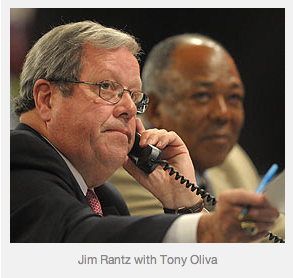
Jim Rantz is a “baseball lifer” who knows a thing or two about talent, personalities, and wisdom.  A former minor league pitcher, who joined the Minnesota Twins organization when they were still the original Washington Senators, Jim moved into the front office in 1966 and he has never left the organization he loves.  He is now the Twins’ Senior Director of Minor Leagues, and has been since 1986. In 2007, Jim was inducted into the Minnesota Twins Hall of Fame.

As a “baseball man” through and through, Jim is quite familiar with my father, Del Wilber, and recently I had the distinct pleasure of chatting with Jim for a bit, on the phone.  Although we know too many people in common to possibly connect all the dots, I don’t believe Jim and I had ever spoken before, so it bears a mention that our phone call was set up by Dave St. Peter, the Twins’ President and one of the most active and helpful members of our Advisory Board here at TPGF.

Jim and I chatted for a bit about the Wilber family and my lifelong connection to the Twins, but before I knew it he was telling colorful stories about Big Del, and I was soaking them up as fast as he could deliver them. It was a treasure trove of heartfelt comments, and I appreciated every word of it.

Something even better came not too long after, when Jim reached out with a quick note to reinforce what we had talked about, while adding in some details we had not talked about, including the fact that he had played for Dad, in the Florida Instructional League. That was a fact of which I was previously unaware.

Here, in its entirety, is what Jim passed along.

I hope you enjoy his words as much as I did.

Bob Wilber

~~~~~~~~~~~~~~~~~~~~~~~~

Bob,

It was really great to chat with you today, about Twins baseball and your father. Your dad was a truly great person, and one of those “bigger than life” personalities that no one will ever forget.

I wanted to tell you that I had the pleasure of playing for him one fall, in the Florida Instructional League way back in the early 60s, and that was some of the most fun I ever had playing the game. Del always made sure we worked hard but had fun, because you play your best when you’re enjoying it. As players, we saw him as a big teddy bear but we also viewed him with enormous respect, because of the playing career he’d had and all the legends of the game he played alongside. When you’re young and in the Instructional League, it makes a big impact to know your manager not only played successfully in the big leagues, but he did it alongside guys like Ted Williams and Stan Musial.

Your dad knew the ins and outs of the game for sure, and he had a great baseball mind. When he instructed, it was to the point but he took the time to tell us why were were learning those drills, rather than just put us through them. He loved telling stories, and I can tell you that just about anyone he ever met enjoyed hearing them.

One other thing I remember about that Instructional League season was that it seemed to us that he never left the ballpark. We’d get there at 9:00 a.m. and he was in full uniform, waiting for us. We’d take our showers and get ready to leave at the end of another long hot day, and Del was still dressed, and still telling stories. We figured maybe he kept telling us stories just to keep us at the ballpark for as long as he stayed.

I think the most important thing, though, is that whenever you think of Del Wilber, the first thought is always about what sort of person he was. He was bigger than life, but he was a player’s manager who always interacted with us one-on-one. Whether he was playing, managing, coaching, or scouting, he was dearly loved by all who had the pleasure of working with him.

Your dad will always be missed.

Take care, and best of luck with The Perfect Game Foundation. It’s a great cause.

Jim Rantz

Reconnecting With Ken Holtzman

HOME / Reconnecting With Ken Holtzman

January 25th, 2012

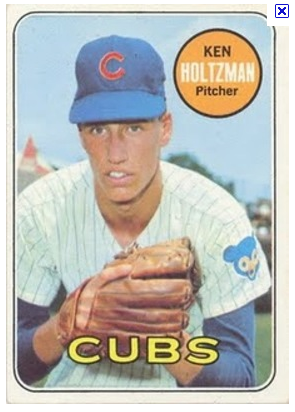
Ken Holtzman pitched in the big leagues for 14 years, winning 174 games on the strength of a sterling career ERA of 3.49, while striking out 1,601 batters, hurling for the Cubs, A’s, Yankees and Orioles.  Born and raised in St. Louis, Ken and my oldest brother Del Jr. were on the same path throughout their developmental years, as they matriculated through the local amateur baseball scene.

Ken attended University City High School, graduating in 1963, while Del Jr. excelled in both academics and sports at St. Louis U. High, also earning his diploma in ’63. Both players went on to Big 10 colleges, with Ken attending the University of Illinois while Del became a Boilermaker at Purdue, and both made their mark in the classroom as well as on the field.

Throughout their childhoods, their parallel paths in the St. Louis amateur baseball scene were eerily the same, and through the years they not only became acquaintances, but friends as well. Both ended up being selected in the 1965 MLB draft (Ken by the Cubs, Del by the Phillies).  To this day, Ken considers our father, Del Wilber Sr., to have been the first scout who “discovered” him. Big Del attempted to sign Ken to a Twins’ contract out of high school, but as you’ll see below Ken instead headed off to Champaign, Ill., to get his college degree.

Recently, thanks to TPGF, Del Jr. and Ken were able to make contact again, catching up on many of the memories they will forever cherish and never forget.

The following segment is Ken Holtzman’s recent email to Del Jr., after their “reconnection” decades after their playing days were over.

We hope you enjoy this brief trip down Memory Lane, as written by a ballplayer who made it to the top.

Bob Wilber

~~~~~~~~~~~~~~~~~~~

Del:  I just got your correspondence about your new organization and was impressed by your efforts in creating something so important and long overdue.  As you know, I have fond memories of your mother and father going back many years.

It seems like only yesterday that your dad took me up to Bloomington, Minn. to pitch batting practice to the Twins, and I was shaking in my boots when I had to pitch to Mincher, Killebrew, Allison, Rollins, et al.  But, your dad  calmed me down long enough to get the ball over the plate and then he took me up to Mr. Brophy’s office to talk about signing a contract.  My father, unfortunately, turned it down in favor of a grant-in-aid to the University of Illinois but, I think, ultimately it was the right decision.

After getting my bachelor’s and master’s degrees years later, I often wondered what would have happened if I had signed with the Twins that day.  I was fortunate, however, to have played in many World Series games with some great teams so I think it worked out okay for me.

I also remember being on your mom’s radio show at the KMOX studio on Hampton Ave., and being so nervous (it was my first time on radio) your mom had to calm me down in order to talk clearly.  She was the nicest lady and I know she was proud of all her kids who turned out so well. I still live in the St. Louis area (Grover) and occasionally I wander into Kirkwood near your old house or drive past SLUH when I eat dinner in the city, and I remember all the good times we had.  I firmly believe that the high level of competition that existed in the amateur leagues that we sprang from was directly responsible for any success I had in the Major Leagues.  From Khoury League and American Legion to high school and college ball, when you were at Purdue and I was at U of I, we got to play at a high level at an early age.

My memories of those years are just as vivid as my experiences in the Majors and probably just as important.  My father has been gone now for many years and my mother (now 88) is in a nursing home with Alzheimer’s.  I know they’d be very happy that we were able to re-connect and I hope you’ll keep me posted with the progress of your new endeavor.   I hope this note finds you well and that you are successful in all your efforts.

Ken Holtzman


Leadership

HOME / Leadership

December 2nd, 2011

Although The Perfect Game Foundation and the Bob On Baseball blog were both established to be baseball-centric, we’ve always had a bigger-picture goal of eventually expanding to assist young aspirants in other endeavors within the sports world.  That will come someday, but in the meantime we’re also aware that stories can come along that are simply too good to pass up, and today’s story of leadership is just such a story.

Used here with the permission of the author, Sally Jenkins of the Washington Post, this story vividly explains what true leadership is, what it looks like, sounds like, and how it works.  It’s a truly terrific explanation, and a great read.  It may not be a baseball story, concentrating on balls, strikes, and outs but it is a sports story that easily hits the subject matter out of the park.

Enjoy!

Bob Wilber

~~~~~~~~~~~~~~~~~~~~~~~~~~

Tim Tebow shows that in sports, there’s no faking leadership (and Bruce Boudreau and Randy Edsall could take note)

By Sally Jenkins, Published: December 1

In a real crisis, like say if an asteroid threatens to strike the planet, I want Tim Tebow as my leader. I don’t want University of Maryland football coach Randy Edsall, with his faux-militaristic carping, or recently fired Washington Capitals coach Bruce Boudreau, with his abrupt shifts from friendly buddy talk to deafening profanity.

“As iron sharpens iron, so one man sharpens another,” Tebow, the NFL quarterback, told his Denver Broncos teammates solemnly last week, quoting Proverbs. If anyone else said that, the room would have erupted into hooting laughter. When Tebow said it, people believed in him.

People didn’t believe in Boudreau and Edsall, for all of their shouting. Yet they believe in a scripture-spouting kid with a hitch in his arm. Why? Possibly because Tebow grasps something about leadership that Boudreau and Edsall have yet to learn: It’s not about domination but about persuasion. Someone who tries to force others to do his bidding isn’t a leader; he’s a warlord. Leadership only works when other people find you credible and grant you their cooperation.

In the past few weeks, area coaches have given clinics in failed leadership. The Washington Capitals staged a virtual work stoppage on the ice under Boudreau. The Maryland football team quit so badly on Edsall, they lost seven consecutive games by double digits. And the Washington Redskinslost six in a row thanks in part to Mike Shanahan’s misjudgment that the happy-talk of quarterback John Beck was leadership, only it turns out they trust Beck’s fellow signal-caller Rex Grossman more, even when he throws interceptions.

Meantime, Tebow has given us a starkly powerful display of the real thing, and so has the underrated leader who had the guts to hand the team over to him, Broncos Coach John Fox.The Broncos are 5-1 over their last six games, and Fox was smart enough last Sunday to ask Tebow to give the pregame talk that led to a crucial overtime victory over the San Diego Chargers and put them in the playoff hunt.

“I’ve never seen a human who can will himself to win like that,” Broncos linebacker Von Miller told the Denver Post afterward. “He gave us a great speech. We came out fired up. And that was a wrap.”

So what exactly is that mysterious quality called leadership? It’s not exactly charisma; it doesn’t hurt that Tebow gleams like a superhero, but the worst despots are charismatic too. It’s not exactly talent, either. According to experts, one reason we struggle to define it is because we look at it from the wrong side up.

“The academic study of leadership has failed, and the reason is that it focuses on the leader, when the appropriate focus is on the followers,” suggests research psychologist Robert Hogan, who profiles executives for Fortune 500 companies. When we flip the examination of leadership on its head and look at what followers will follow, we get a better idea of what quality we’re talking about.

“What is it the followers are looking for?” he asks. “The focus should be on the work force or the team, and what they perceive. Because if they don’t perceive the right thing in a leader, you’re through.”

Okay, so let’s talk about followership. The truth is, it’s not in our human nature to “follow” anyone very willingly, from an evolutionary standpoint. Anthropologist Christopher Boehm asserts that for 2.5 million years hunter-gatherer societies were so egalitarian they wouldn’t tolerate such a thing as formal “leadership.” Bands awarded temporary authority only for coordination: Someone had to plan the hunt. As soon as the group doubted his competence, or regretted awarding him control, they had clever ways of ridding themselves of him, which anthropologists coolly call “leveling mechanisms.” They ranged from ignoring orders, to casting out of the tribe, to killing.

Seem familiar? Sounds like Boudreau got leveled by a mechanism. Edsall, too.

According to Hogan’s research, followers want four things: integrity, confidence, decision-making and clarity. But just as important is what followers don’t want: irritability, moodiness, untrustworthiness, indec­i­sive­­­ness, needless micro-management and excessive authority. They perceive these things as incompetent, and pretty soon the leveling mechanism kicks in and there is a subtle rebellion. (Incidentally, I would be a terrible leader, according to Hogan’s personality test. Too irritable. “Volcanic,” he announced.)

With that in mind, let’s reconsider our local teams, and ask why the followers refused to follow.

Boudreau is an extremely likable man and expert coach; the Capitals followed him cheerfully until this season, and he was hired by Anaheim less than three days after getting fired. But after winning just two playoff rounds in four years, Boudreau decided he needed to get tougher, especially on star Alex Ovechkin. This from a guy who already had a nasal intensity, and who before his first-ever practice with the Capitals in 2007 decided to chastise Ovechkin solely for the purpose of making an impression. And who in 2010 was captured on tape giving an intermission diatribe that consisted of 17 obscenities in 90 seconds. Deafening profanity can be useful — until it’s numbingly repetitive. At a certain point it didn’t motivate anymore and became tiresome. “If people say, ‘He’s just manipulating us,’ at that point you’re done,” Hogan says.

Edsall’s act with the Terps was just sort of low and snarling and alienating. He treated the nine-win squad he inherited from the far more accomplished Ralph Friedgen as if it was in need of discipline and not up to his standards. But there’s a difference between rigor, which builds confidence, and petty puppeteering, which destroys enthusiasm. Fact is, Edsall’s never won anything bigger than a PapaJohns.com Bowl. Some of the Terps responded by nicknaming him the “warden” and by playing with stunning lassitude and apathy, losing 10 games.

Edsall has shown zero recognition he is the problem; instead he had the temerity to compare himself to the New England Patriots. Edsall might want to look at a study on airline crew performance that Hogan cites. It found that the number of flight errors significantly correlated to the personality of the captain. Crews led by captains perceived as agreeable, self-confident and emotionally reliable made the fewest errors. Crews with captains considered arrogant, hostile, passive-aggressive or dictatorial made the most errors.

Leaders lose their teams, Hogan says, for the simple reason that followers withdraw their consent to be led. The late Red Auerbach, the legendary coach and executive with the Boston Celtics, always said that you don’t motivate teams, you motivate players, one by one, by building relationships.

“The key to the relationship is trust, and if they don’t trust you, you’re done,” Hogan says.

A leader is worth nothing without voluntary commitment, because the followers are actually more in charge of the outcome. Every aspiring leader should ask, “Would people choose to follow me?” and understand who the boss really is.

Q & A with Corrine Vitolo

HOME / Q & A with Corrine Vitolo

November 22nd, 2011

We recently asked Corrine Vitolo a few questions regarding her business career, interests, and the business of baseball. Here’s what she had to say:

Q. Tell us about SmartSports – what is the business all about and how did you create it?

In short, we are the physical SAT®. We’ve developed the first quantitative tech system that measures athletic performance; our first market is baseball, football next. Beyond the stopwatch and radar gun, there has been no standardization in sports. We focused on that enormous void — while simultaneously addressing inefficiencies in scouting and player development — and built the solution.

SmartSports emanated largely by chance. I was approached in 2003 by my now partner and co-founder, Larry Scannell, who played for the Red Sox. He had the makings of a great idea; I wanted to pursue something innovative in the space. His background as a player and instructor, coupled with mine in sports management yielded a pretty exciting company…. We’re ready to launch our SmartKage system to 160 locations in the US, have the best partners in technology and baseball, and already have additional products in the pipeline. It is terrific time for us.

Q: Over your career, what position you have held was the most challenging and why?

I’ve always been in the sports business; my early career served Fortune 100 companies business interests in MLB, NFL and Motorsport, largely in strategy and operations. At the time, dealing with multinational companies seemed complex simply by virtue of the size and structure of the organizations. Looking back, it was comparatively simple to what I am doing now.

Any position as CEO is demanding. In SmartSports, it has required an incredible level of stamina. Managing technology development, capital markets, investors, and general organizational matters in parallel necessitates intense focus and dedication. That said, it is absolutely the most gratifying thing I have ever done.

Baseball as a business is somewhat underserved — it’s unique heritage and unmatched legacy as a sport remains somewhat unrealized to its potential. From a business perspective, we are facing substantial shifts in how fans interact with sports. Those of us trying to bridge the gap from past to future are challenged with serving multiple constituencies well, and to a degree, having a correct execution of prediction. America’s pastime is coming quickly into the future… my challenge is to ensure that we have aptly anticipated and correctly equipped that market to engage, and grow.

Q.  Who was a mentor to you in your career and why?

I’ve been blessed with only one: Jerry Welsh. As head of worldwide marketing for American Express, Jerry became best known as the founder of cause-related marketing. His projects always involved something meaningful — not de rigueur in the day: his accomplishments originated from his extraordinary conscience. In my opinion, he is one of the best quiet leaders in the history of US business.

Without ever overtly discussing, he is the one that taught me how to make business work for something larger than the immediate, how to leverage what you had to make the world a better place — in any increment. He saw, he recognized, and he believed in me. Funny, I’ve worked with a lot of very high profile people… I’d say I have been most touched to be considered one of “Jerry’s Kids”…..

Q: What are the most important business lessons you have learned in life?

They have been one and the same: be true to yourself. The rest will follow.

Q: Over your career you have been a consultant, a CEO, a writer and teacher (among other things)  —do you prefer one or two of the those to the others?

No preference, though, my sense is that my current position is the one that will leave the most meaningful fingerprints.

Q: What advice would you have for women aspiring to a career in sports ?

Do it, and go big. Sport is one of the few common denominators in life that transcends any categorical label. Indeed, women are few: all the better reason and opportunity to make your mark.

Q: Talk to us about the Science of Sport — as all training becomes more sophisticated where do you see things going next?

Our entire culture has shifted to science — technology is simply an expression of that. This generation of athletes has exponentially more information available to them — all the better to guide them. Whether through training, conditioning, nutrition, or coaching…. science is the catalyst that is moving all sport forward.

There are a lot of emerging corollaries that are interesting… I think the ones that will matter are the ones that can remain invisible to the user. Smart wearables are easy and scalable, there should be good traction in that. I think some of the most important things I’m seeing are on the predictive realm. For example, after several of our SmartKage sessions, we have enough data to show trend lines… wouldn’t you like to be able to prevent a pitching injury before it happens? We have the science, now it’s simply a matter of implementation.


Q: What do you feel has changed most in the Business of Baseball in the past 10-15 years?

I think it’s the wonderful offshoot of technology: fan interaction. In previous generations, baseball was essentially limited to either a broadcast, or going to a game: it was a finite exposure. If you blinked, you missed. With on-demand information, casual fans have escalated their interests into lifestyles. Via television, phones, devices — all have augmented the fan’s activity level. MLBAM is on top of it for sure, but there is still plenty of space to be addressed. It’s still very much an evolving proposition.

Q: What is your favorite sports moment as a fan?

Ironically, it was completely independent of business. Two very distinct moments in my life, both football related.

I grew up next to the Shula family in Miami. I was a kid, and it wasn’t until I was in college that I realized how extraordinary it was that Don was the one who taught me to throw a football.

More poignantly, when Walter Payton was inducted into the Hall of Fame. He was an amazing athlete, with the biggest heart I’ve ever known. He was a very dear, very missed, friend.

Q: What are your favorite passions outside of work?

Quietly doing good. And very serious driving.

Q: Why would you encourage someone to enter sports as a career?

For the very same reason I was so exited to get involved with TPGF: because you can make a difference. At the end of the day, there are a million businesses you can get involved with — the question is, what matters? Business is only as meaningful as the people it touches. Sport is one of the few places of true commonality between industry and humanity. It may sound dramatic, but it is true. Seldom can business impact people directly: sports can. Any aspect promotes good values: health, personal development, growth, sportsmanship, achievement  — all qualities that positively effect the human condition.  Beyond, there is so much opportunity for growth. There truly are no limits in what one can do.

Welcome Guest Blogger Tara Wellman

HOME / Welcome Guest Blogger Tara Wellman

November 15th, 2011

On this installment of Bob On Baseball, we welcome another fine young writer who is striving to make her mark in sports.  I met Tara Wellman at the U.S. Nationals, one of the biggest drag races in the world, when I was busy handling my “real job” as Team Manager for Tim Wilkerson’s NHRA Funny Car team.  Tara was “dragged” (pun intended) to the race by a friend who was already a fan. Within minutes of meeting her, our mutual love of baseball became the topic and the sheer determination I could see in her eyes impressed me. I immediately knew that this young lady was focused on career success, and nothing I’ve seen or heard from her since has diminished that assessment.

Tara is an aspiring sports journalist whose first love is baseball (more specifically, St. Louis Cardinals’ baseball!)  She completed her undergrad degree at St. Ambrose University in Davenport, Iowa in May 2010, double-majoring in Journalism and Radio/TV Production. Since then, she’s gone on to host a local television show, direct local sports broadcasts, write for a new online sports network (AerysSports.com), host her own blog about her other sports love – figure skating – and interview past, present, and future champions along the way.

She describes herself as a dedicated sports fan, a passionate story teller, and an undeniable dreamer. Tara has big plans for her career, but they all center on finding great stories and telling them with a creative twist – the kind of stories you just can’t put down. When not working or writing, she enjoys watching Sports Center, playing the piano or guitar, and relaxing at Starbucks.

Enjoy Tara’s work, and remember her name. She will not stop short of success.

Bob Wilber

~~~~~~~~~~~~~~~~~

“If you’re not going to play to win, why play?”

That was my grandpa’s motto for anything competitive. Don’t just muddle through, strive to be the best. He taught my mom well – she was the star of her high school basketball team, an excellent softball player, and later, a high school basketball coach. (She never backed down at Candy Land, either. Or Skipbo. Or Pictionary. …you get the idea. If I was going to win, I had to earn it.)

In my family, you play to win. Not because winning is everything, but challenging yourself to achieve something great is.

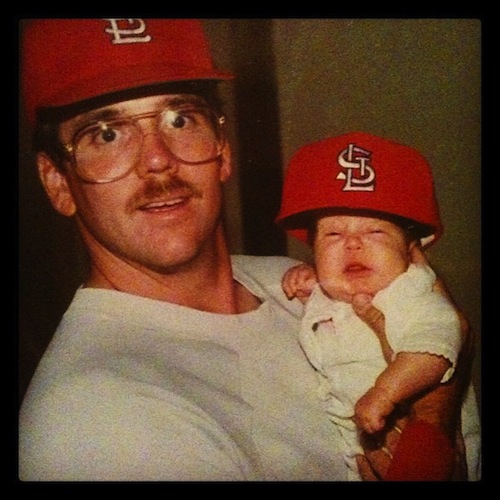
A very young Cardinal fan, and her proud father

My dad, then, introduced me to other sports. A native St. Louisian, his priorities were always the home team, and topping that list, the Cardinals. He was a fan when there wasn’t a lot of good baseball played at Busch. But he believed in them, cheered them on, and loved them through it all.

Similarly, I’m never short on support from the home front. Not because I never fail, but because they believe one day I will succeed.

Like any kid, my life goals changed as often – and as dramatically – as the seasons in my hometown’s mountain west climate. Singer, artist, detective, Olympian, president, and ultimately, writer. But that last one didn’t come until much later – my junior year in college.

I wasn’t much for making decisions. I wanted to do too many things to pick just one! I’d settle on something like photography, only to be discouraged by all the things I’d have to leave out to make that work.

To add to the confusion, teachers and friends had a whole different idea for my life – I should be a teacher, like my mom. (Not because I’d actually be any good at it, mind you, but simply because, well, like mother-like daughter, right?)

Whatever I chose to do, I wanted two things – to love what I do so much that it hardly felt like work at all, and to be the best at it … or at least try. If I’m not playing to win, why play?

The journey to my current post as a sports journalist is long, winding, and not entirely interesting for the average reader, so I’ll spare you the details. To sum it up, my parents – who had never pushed one direction or the other – offered a new idea: Do what I already love, no matter what others might say. And, of course, strive to do it as well as I possibly could.

So, after a dramatic program shift followed by two years of overwhelming myself (in a good way) with the activities of sports writing, radio announcing, and television reporting, I was off to the real world. Little did I know that all those things people say about women in sports would be more accurate than I was willing to admit.

It’s tough being a girl who likes baseball more than beauty products. Convincing hard-core sports fans that I know what I’m talking about – and can write about it just as well as their favorite male writer! – is a constant battle. And good luck being chosen for a sports job over an equally qualified “sports guy.”

It’s tough.

But my grandpa taught me well.

I worked hard, took some risks, and gave up once-necessary sleep to make it work. And I spent this baseball season doing something many people never considered possible – writing for an online sports network about my beloved St. Louis Cardinals. Yes, you saw that right. A girl who grew up learning about baseball from her dad (who, by the way, always told her she could do anything the boys could do!) documented what turned out to be an historic whirlwind of a season that ended in the best way possible … World Champs, anyone?

A loyal Cardinal fan for life!

Just in case I didn’t learn my lesson on stick-to-it-ive-ness from my deeply competitive and supportive family, the 2011 Cardinals were a superb reminder.

The season (in which they were favored at the start) wobbled on a tight rope-thin edge for months as expert after expert calculated the reasons this team would never make it all the way. In late August, when things had taken the worst turn yet, the 10.5 games separating the Redbirds from the playoffs nearly proved those experts right.

Thus began the greatest comeback in major league history, thanks to a team that, as announcer Joe Buck would eventually say, just wouldn’t go away.

They played to win, and they would settle for nothing less than their utmost effort to do just that.

They could never make the playoffs. But they did.

They could never beat baseball’s golden-child Phillies. But they did.

They could never take on their “beastly” league rivals – the ones who had run away with the division – to claim the National League pennant. But, again, they did.

And again, and again, and again.

Even when they found themselves a strike away from losing game six and watching the Texas Rangers celebrate their first ever World Series win on the Cardinals’ home turf, they battled back. Not once, but twice. And in the most appropriate way possible, the never-say-die “Cardiac Cardinals” powered their way around the “experts’” predictions yet again and forced a game seven.

Oh, and, they won that, too.

In the eyes of their adoring fans, there was never any doubt, and never a better moment.

Some may say, “It’s just baseball,” but look what this team’s resilience proved: Cliché as it might sound, don’t ever, ever give up.

It’s not about what anyone else says. It’s all about what you do.

I learned how to compete at an early age. I learned to live passionately as I developed what I loved. I accepted the challenge of a career that would take plenty of work, knowing that, no matter the “experts” counting me out, it’s possible to prove them all wrong. And that, no matter what, there were those who would always have my back – they would always be my biggest fans.

I love what I do. Telling a story that taps into an audience’s emotion isn’t just a job, it’s a passion. And while I’m not there yet, I’m striving to be the best. Not because I need accolades to quantify my success, but because, well, it’s what I do.

I play to win.

Welcome Guest Blogger Coral Rae Marshall

HOME / Welcome Guest Blogger Coral Rae Marshall

October 19th, 2011

Today, here at Bob On Baseball, we welcome another guest blogger to our ranks. Coral Marshall is a graduate student in Sport Management at California State University – Long Beach. She did her undergrad work at the University of California – San Diego, where she studied Communications and Russian & Soviet Studies. He passions include all things baseball, communication theory, Russian literature, studying new media, and reading by the pool (her words!)

Coral is a wonderful example of exactly the type of person The Perfect Game Foundation looks to assist, as she aims to find her place and make her mark on the business side of our great national pastime. Her succinct interpretation of how legends and heroes are born is first-rate, and a fine read.

Enjoy!

Bob Wilber

~~~~~~~~~~~~~~~~~~~~~~

Legends and Heroes

This year, Major League Baseball’s advertising executives have latched onto the post-season phrase “Legends Are Born In October,” but it seems that the word legend undermines the greatest parts of baseball itself.

Merriam-Webster defines legend as “a story coming down from the past; especially: one popularly regarded as historical though not verifiable.” What is great about baseball is its authenticity. Its truthfulness. Its veracity. Baseball is great because (at least in the modern era) there are no baseball myths, only baseball facts.

Yes, there are baseball legends. The legend of Babe Ruth’s alleged 715th home run (was he in or out of the batter’s box?). The legend of Shoeless Joe Jackson (what exactly was his involvement in the Black Sox Scandal?) But, like many, those legends are nearly a century old, and not all of them were born in October. They are not verifiable only because there was not the technology present at the time to verify them, and because baseball statistics were not nearly as revered in that time period.

Baseball in the modern era is a completely different ballgame (pun intended). Statisticians, fans, bloggers, writers, television crews, and so many more are continually critiquing every move made by every player on (and off) the field. Baseball is constantly and continually checked and verified in October, 2011, leaving fans not with legends or things of myth, but instead with something more powerful: Heroes and their epic narratives forever documented not only in memory, but on film and in statistics. Yes, October baseball does not birth legends. October baseball births heroics.

But, even the idea that these players and their tales are born in October seems to negate the value of the other 162 games that each team played to fight their way to the final eight spots of 2011.

The legend, myth, heroics, or whatever one might call it, of the 2011 St. Louis Cardinals did not begin in October. The heroics of this team began at their first spring training game. The heroics of this team continued as they clawed their way past the Atlanta Braves and into the National League Wild Card spot. The heroics of this team became evident when they beat the heavily-favored Philadelphia Phillies and their “dream team” of pitchers. Chris Carpenter and the rest of the Cardinals became inspirations when they showed they possessed the resolve to beat the best pitching staff money could buy. The heroics of this team were cemented when they destroyed the Brew Crew and became the 2011 National League champions.

Albert Pujols is not merely a legend. Albert Pujols is an inspiration to those who have been told they will never make it (he somehow slipped to the 13th round of the draft in the year he was selected) but yet manage to rise above those expectations, and to those who yearn to lead their team to victory. Calling these feats “legend” discounts the veracity and the very nature of their heroics.

Some may read this and argue that calling baseball players heroes may be inaccurate as well. According to Merriam-Webster, a hero is “a man admired for his achievements and noble qualities.” It seems that the Cardinals, in surpassing the Braves an defeating the Phillies and Brewers, have embodied the American Dream; the dream that no matter what one is given (in this case a significantly smaller payroll, according to Forbes.com, witha less-highly touted starting rotation), one can pull one’s self up and achieve their goals. The dream that through teamwork and dedication one can overcome the odds. The dream that nothing is impossible.

Justin Verlander displayed similar heroics this season for the Detroit Tigers. Verlander won a league-high 24 games this season. More impressively, he led the league in ERA, WHIP, strikeouts, and innings pitched. Yes, Justin Verlander brought the American League’s pitching version of the Triple Crown, and playoff baseball, to Detroit but Verlander’s story did not begin in October. Verlander’s story began on March 31, in New York as the Tigers started the season 0-1. Verlander proved that he could bounce back from defeat, 24 times, and become a lock for his first Cy Young Award. Verlander showed young kids everywhere to “try, try again”. Verlander’s willingness to start on short rest in the playoffs is not legendary it is heroic in his commitment to his teammates, to winning, to excellence, to hard work, and to the fans of the Detroit Tigers.

Legends are not born in baseball, and they are not born in October. At least in 2011.

In 2011, heroes are proven in baseball.

– Coral Marshall

Q & A with Francisco Arocha (English and Spanish)

HOME / Q & A with Francisco Arocha (English and Spanish)

September 11th, 2011

We recently asked Francisco Arocha a few questions regarding his business career, interests, and the business of baseball.  Here’s what he had to say:

Q: Tell us about the HES Group?

HES stands for Hospitality, Entertainment and Sports. Twelve years ago we decided to dream and we wanted to work in industries where we could enjoy every day. First it was a hotel, then a baseball team and then many different projects. Some were small and others larger. Sometimes with huge success others with little luck, however each project was a new adventure that required a lot of commitment and energy but above all  we are accomplishing our goal of enjoying each and every day.

Q: What was your first job, and what did you like or dislike about it?

I started as a lawyer. After graduating from Law School almost twenty years ago I joined the Attorney General’s Office of Venezuela.  We were a team of young professionals willing to do our best for our country and while it was not easy we did extremely well and learned to work under a lot of pressure and scrutiny. We also learned that it takes hard work to succeed in whatever you do in life. During that time we got to meet many people, built a reputation and opened our own law practice which is when we began to get involved in business deals and quite soon we decided to get more involved in business operations.

Q: What is it about the Business of Baseball that you enjoy so much?

Baseball in our country (Venezuela) is huge and it is part of everyone’s life. During the last two decades there has been an important development in baseball which is the increasing number of Latin players in Major League Baseball. While some decades ago there were only a few Venezuelan players in the Big Leagues today almost every MLB team has at least one Venezuelan on its roster. If you take a look to the Minor Leagues you will also see a lot of Venezuelan talent and being part of this industry is priceless because it is challenging and fulfilling. You are part of a very special industry where your customer regardless of his degree of education can be extremely demanding because he understands your business. The difficult part is that emotions are involved– It is not just a business plan… you need to perform and in our countries you need to win. It is a constant challenge and there is not a written recipe for success. We have done well over the past seven years turning around a professional team in Caracas that was a family business and about to sink when we took control of the operations. Now, though, we still need to win a championship!!!!

Q: Who was a mentor to you in your career and why?

I have been extremely lucky because at every step in my career I have found great people and I have received strong support from many of them. Every opportunity I got I did my best and in almost every case I have succeeded and more importantly even when not I have managed to make the best of each opportunity and learn from it. Twenty years ago I worked under the supervision of one guy who eight years later partnered with me to launch HES. It has been a solid partnership and we have supported each other and found a way to work and dream together. Trust, commitment, loyalty and hard work have helped us establish a small group of solid companies.

Q: What kind of business opportunities do you see in sports for Hispanic men and women?

Minorities bring diversity as I learned a while ago when I got my first scholarship to go abroad and study law in Paris. It happened again when I got a Fulbright Scholarship and went to Harvard. It happened later when I did my executive MBA in Columbia. The business world becomes more global every day and in a global business world there is space for those who can add value. Diversity itself is an important element in every industry where you want a wide customer base. While in the past you only saw Hispanics on the field, Today you will find them everywhere…. Ozzie Guillen and Omar Minaya are two great examples of how far a Hispanic can get in the sports industry

Q: Over your career you have played many roles in the businesses you own  – baseball teams, hotels, food service, restaurants – is there one of these industries that you find more exciting and rewarding than the others?

While baseball is the one representing the bigger challenge it also is the most rewarding because in baseball you get connected to people in a unique way. Baseball unites people and ignites passions and while baseball has evolved with today’s cybermetrics supporting many decisions, you need more than academic background or business experience. Everyday and every game is a challenge and you need to be connected to your team and to your fan base. Our league is a small league of only 8 teams and there is pressure to clinch the playoffs but that will never be enough because whatever you do your customers/fans will always want much more….I love it….

Q: You and your family are currently relocating to Miami – why the physical move to the U.S. ?

We are dreamers and believe there are many opportunities around and in Miami as it is a crossroads between Latin America and the rest of the world. We just established a new headquarters in Miami and in less than a year we have been able to get involved in two important hotel deals. While still a small group our dreams for the sports and hospitality industry are big. We get new projects and proposals quite often and our goal is to find some good opportunities to be able to put in place and execute sound business plans

Q: Talk to us about the Business of Baseball—what do you feel are the three most critical factors for a baseball team to be successful in today’s climate?

First, a solid player development strategy which allows you to sign good prospects constantly in order to keep your team competitive season after season; second works towards the establishment of a solid fan base to keep the team profitable and third you need to bring appropriate leadership in order to keep all the players and staff aligned to help the team succeed throughout the whole season…

Q: What do you feel has changed most in the Business of Baseball in the past 10-15 years?

When you are part of the industry you realize the big steps taken during the past decade. Baseball is not just the huge stadiums or the broadcasting of every game of the season because the greatest improvement is the establishment of a huge baseball network that goes well beyond the MLB season and today includes the minor leagues, fall leagues, summer leagues, winter leagues, spring training seasons, etc etc…. Everyday there are more people playing baseball in different corners of the world and there is a huge commitment to keep baseball growing and growing….

Q: What is your favorite sports moment as a fan?

To catch a ball in  the stands! You can be at a MLB stadium or even at a minor league venue and a foul ball flies in the direction of where you are seated and you will always feel in internal emotion and desire to catch that ball as it happens when you are a kid and it happens when you are an old man.  I have been to thousand of games and being the CEO of a baseball team I could have as many balls as I want but I will never forget once at Fenway Park when studying in Boston, my seat was between third base and left field a foul line drive came straight to me and I tried to catch it but lost control. It hurt my hand and my heart and I have never again had a foul ball come close to me.

Q: What are your favorite passions outside of work?

Travel. I love it and traveling around the world has helped me understand and live different cultures. I have lived in the US, Europe and Latin America and have been able to travel extensively around the world.   I plan every trip to the detail and always include attending some sports events wherever I go.

Q: Why would you encourage someone to enter sports as a career?

From my perspective there is not another industry where you could enjoy more what you do for living……..

Our interview with Francisco Arocha in Spanish:
Recientemente le hicimos algunas preguntas a Francisco Arocha sobre su carrera profesional, sus intereses y el negocio del béisbol. Sus respuestas fueron las siguientes:
P: ¿Qué nos puede decir sobre HES Group?HES significa en español Hospitalidad, Entretenimiento y Deportes. Hace doce años comenzamos a soñar y decidimos trabajar en áreas que podríamos disfrutar todos los días. Lo primero fue un hotel, seguidamente un equipo de béisbol y después muchos proyectos diferentes. Algunos fueron pequeños y otros más grandes. Algunos fueron muy exitosos y otros no tan afortunados, pero cada proyecto fue una aventura nueva que requirió gran dedicación y energía, pero, por encima de todo, estamos cumpliendo nuestras metas y disfrutando cada día.

P: ¿Cuál fue su primer empleo y qué le gustó o disgustó del mismo?

Comencé como abogado. Después de graduarme de la escuela de leyes hace mas de veinte años, me contrató la Fiscalía General de Venezuela.  Éramos un equipo de profesionales jóvenes con deseos de hacer lo mejor por nuestro país y si bien no fue un trabajo fácil, nos fue sumamente bien y aprendimos a trabajar bajo mucha presión y escrutinio. También aprendimos que hay que esforzarse mucho para triunfar en cualquier cosa que se haga en la vida. Durante este período conocimos a muchas personas, establecimos nuestra reputación y posteriormente iniciamos nuestro propio escritorio jurídico. Mas adelante, comenzamos a involucrarnos en diferentes negocios y muy pronto decidimos participar más activamente en operaciones empresariales.

P: ¿Por qué disfruta tanto del negocio del béisbol?

El béisbol en nuestro país (Venezuela) es importantísimo y forma parte de la vida de todas las personas. En las últimas dos décadas ha ocurrido un cambio importante en el béisbol que consiste en la participación cada vez mayor de jugadores latinos en las Grandes Ligas. Si bien hace algunas décadas había unos pocos jugadores venezolanos en las Grandes Ligas, prácticamente cada equipo cuenta actualmente con al menos un venezolano en su roster diario. También vemos a una gran cantidad de talento venezolano en las Ligas Menores y formar parte de esta industria es invalorable debido a sus retos y satisfacciones. Formamos parte de una industria muy especial donde los clientes, independientemente de su nivel educativo, pueden ser sumamente exigentes porque comprenden el negocio. Un aspecto difícil son las emociones que se sienten – No se trata sólo de un plan de negocios, además hay que hacerlo bien cada temporada y también hay que ganar campeonatos. Es un reto constante y no hay una fórmula establecida para tener éxito. Nos ha ido bien en los últimos siete años transformando al equipo profesional  que estaba por naufragar cuando tomamos el control de sus operaciones. ¡Ahora sólo nos falta ganar un campeonato!

P: ¿A quién considera un mentor en su carrera profesional y por qué?

He sido muy afortunado por haber conocido a excelentes personas en cada paso de mi carrera profesional y haber contado con el apoyo de todos. Di lo mejor de mí en cada oportunidad que se me ha presentado y en prácticamente cada ocasión salí airoso, pero lo más importante es que le he sacado el mayor provecho a cada oportunidad y en cada una he aprendido algo nuevo. Hace veinte años trabajé bajo la supervisión de una persona con la cual me asocié ocho años después para lanzar a HES. Ha sido una sociedad sólida, nos hemos apoyado mutuamente y hemos hallado una fórmula para trabajar y soñar en equipo. Confianza, dedicación, lealtad y fuerte trabajo nos han permitido establecer un exitoso grupo de pequeñas empresas.

P: ¿Qué tipo de oportunidades  considera que el deporte les ofrecen a los hombres y las mujeres de origen hispano?

Hace tiempo, cuando recibí mi primera beca de estudios en el exterior y partí a estudiar Leyes en París, aprendí que las minorías crean diversidad. Esto volvió sucederme cuando recibí la beca Fulbright y fui a Harvard. También ocurrió después mientras cursaba mi Maestría Ejecutiva en Administración de Empresas en la Universidad de Columbia. El mundo empresarial se globaliza más cada día y en un mundo de negocios globales, hay espacio para quienes pueden crear valor añadido. La diversidad de por sí es un elemento importante en cada industria en la cual se desea tener una amplia base de clientes. Si bien en el pasado los hispanos se veían solamente en el terreno de juego, hoy en día están en todas partes; Ozzie Guillén y Omar Minaya son dos excelentes ejemplos de cuán lejos pueden llegar los hispanos en la industria de los deportes.

P: Durante su carrera profesional usted ha desempeñado varios papeles en sus empresas: equipos de béisbol, hoteles, industria alimentaria y restaurantes. ¿Encuentra a alguna de estas industrias más emocionante y gratificante que las demás?

Si bien el béisbol representa el mayor reto, también es lo más gratificante porque te conecta con las personas en forma diferente. El béisbol une a la gente y enciende pasiones, y si bien ha evolucionado con el apoyo de la cibermetría, se requiere más que antecedentes académicos o experiencia empresarial. Cada día y cada juego presentan retos y hay que estar conectado con el equipo y sus aficionados. Nuestra liga es pequeña ya que está integrada por apenas 8 equipos y existe presión para alcanzar los playoffs, pero esto nunca será suficiente porque independientemente de lo que hagamos, nuestros clientes y aficionados siempre van a querer más… me encanta.

P: ¿Usted y su familia se están reubicando en Miami, ¿por qué se están mudando a los Estados Unidos?

Somos soñadores y consideramos que existen muchas oportunidades dentro y cerca de Miami por ser una encrucijada entre América Latina y el resto del mundo. Acabamos de establecer una nueva sede en Miami y en menos de un año nos hemos involucrado en dos importantes negocios de hoteles. A pesar de ser un grupo pequeño, nuestros sueños para las industrias de los deportes y la hospitalidad son grandes. A menudo recibimos nuevos proyectos y ofertas, y nuestra meta es hallar algunas buenas oportunidades y ejecutar sólidos planes denegocios.

P: Háblenos sobre el negocio del béisbol. ¿En su opinión, cuales son los tres factores más críticos para que un equipo de béisbol tenga éxito actualmente?

En primer lugar, una sólida estrategia de desarrollo de jugadores que permita contratar continuamente a buenos jóvenes prospecto para mantener un equipo competitivo en cada temporada; en segundo lugar, establecer una sólida base de aficionados para mantener al equipo rentable y, finalmente, hay que contratar a líderes apropiados para mantener en la línea a los jugadores y al personal, y lograr que el equipo sea exitoso durante toda la temporada.

P: ¿Qué siente que ha cambiado más en el negocio del béisbol en los últimos 10 a 15 años?

Cuando una persona forma parte de esta industria, se da cuenta de lo mucho que ha avanzado en la última década. El béisbol no consiste exclusivamente en inmensos estadios o la transmisión de cada juego de la temporada, ya que la mejora más importante es la creación de una gran red de béisbol que trasciende la temporada de las Grandes Ligas para incluir actualmente las Ligas Menores, las ligas de otoño, las ligas de verano, las ligas de invierno, las temporadas de entrenamiento de la primavera, etc. Cada día más personas juegan béisbol en diferentes partes del mundo y hay una gran dedicación a mantener el crecimiento del juego.

 P: ¿Cuál es su momento deportivo favorito como aficionado al béisbol?

¡Haber atrapado una pelota en las gradas! Si se está en un estadio de las Grandes Ligas, o incluso de las Ligas Menores, y una pelota es bateada de foul hacia donde uno está sentado, siempre se sentirá una emoción por dentro y el deseo de atrapar la pelota, independientemente de si se es un niño o un adulto.  He asistido a miles de juegos y como Director Ejecutivo de un equipo de béisbol podría tener tantas pelotas como quisiera, pero jamás me olvidaré de una ocasión en que me encontraba en Fenway Park mientras estudiaba en Boston, sentado entre la tercera base y el jardín izquierdo, cuando un jugador bateó una foul en línea directo hacía mí. Traté de atrapar la pelota pero perdí el control y la pelota me lesionó la mano, y mi corazón, y jamás han vuelto a batear un foul hacia mí.

P: ¿Cuáles son sus pasiones favoritas fuera del trabajo?

Viajar. Lo disfruto muchísimo y viajar alrededor del mundo me ha ayudado a comprender y vivir diferentes culturas. He vivido en los Estados Unidos, Europa y Latinoamérica, y he tenido la oportunidad de viajar extensamente alrededor del mundo.   Planifico cada viaje detalladamente y siempre asisto a algún evento deportivo dondequiera que vaya.

P: ¿Por qué alentaría a alguien para que se dedicara exclusivamente al deporte?

Desde mi punto de vista, no existe ninguna otra industria en la que una persona disfrute más cada dia de su vida…

The Unscientific Way To Pick A Bat

HOME / The Unscientific Way To Pick A Bat

July 27th, 2011


Hanging on the wall, here in my home office, are two baseball bats. One is somewhat famous, the other nearly anonymous.  As you can see, they straddle a framed copy of Baseball Magazine, from 1953, and the catcher in the cover photo is my father.

His bat hangs to the left, but it’s not just any Louisville Slugger and it’s not just any Del Wilber autographed model. This very bat is the one he used on August 27, 1951 at Shibe Park in Philadelphia, while playing against the Cincinnati Reds.  On that very night, Big Del achieved something so outstanding we have named this charity in reference to his accomplishment. He came to bat three times, took three swings, and hit three solo home runs, accounting for all of the scoring in the Phillies’ 3-0 win over the Reds. It’s a special bat.

Big Del had his Louisville Slugger designed to fit his needs, and since the bat was specifically cut and weighted to his exact preference, Hillerich & Bradsby designated it as the W15 model.

The bat on the right is one of mine, and one of only two Bob Wilber autographed bats left on the planet. It’s a U1 model, originally designed for some other player, but at some point in my young career I picked one up and liked the feel of it. I therefore, for better or for worse, stuck with the U1 until my fleeting minor league career was over. I blame the U1.

It has a tapered handle, with no knob. That sort of style is usually the favorite of the choke-up slap hitter, but I took a full swing like a power hitter. My theory, passed along to me by many head-shaking coaches, was “Swing as hard as you can, in case you actually hit the ball.”

It has a relatively thick handle as well, and that again worked at cross-purposes with my intent. The thicker the handle, the slower you are able to get the bat head going. A thin handle allows the hands (and the bat head) to rotate more quickly, but a thin handle on a wood bat also creates one other byproduct. If you don’t hit the ball on the big part of the barrel, thin handles sting a lot more.

Since I did not have the quickest hands to begin with, I tended to get jammed every now and then (if, by “every now and then” you mean at least once a game) so the whole “handful of bees” thing was not high on my wish list. The thicker handle on the U1 protected me from the stings, but it probably slowed my bat down even a little further.

So why did I pick the U1 and continue to use it until no one would pay me to play anymore? Was it because it improved my chances for getting hits? Did it maximize my bat speed? Was it the right bat for me? No, no, and no. It just felt good. Back in the day, well before video training and high-tech coaching, two topics were consistently repeated with young players, and the advice was the same in both cases. For your stance, pick something that feels good. For your bat, pick something that feels good. Great stuff. Thanks for thinking outside the box, coaches!

Now, of course, we can visualize and test various stances, to improve any hitter’s chances for success. You still don’t want to be up there totally uncomfortable, but any good hitting coach can spot flaws that are going to make an improbable action (hitting a baseball) closer to impossible. Coaches work with players from Little League to the Major Leagues, finding flaws in their swings and stances. Good coaches make hitters better.

In terms of bats, little progress has really been made in terms of tailoring a bat to fit a swing, but I think coaches and players are a little more savvy when it comes to design. Back in the 1970s, when I was swinging my beloved U1, it just felt good.

The biggest problem we have now, in professional baseball, is the pervasive use of metal bats at every other level of the game. When my pro days were over and I began playing semi-pro ball for the Sauget Wizards, the first thing I noticed was how much faster my bat was, and how much more power I had, swinging an aluminum bat. I was one of the lone hold-outs to use wood in college, while everyone else was making the transition to metal, so my Wizards days marked the first time I’d been brought over and seduced by “the dark side” with a metal bat. The handle could be thin, the barrel could be huge, and the thing could still weigh no more than 31 ounces. Wooden bats couldn’t be made that way, because there wasn’t enough strength in the handle to manage the torque and whip of a big heavy barrel.

Now, we see bats shattering and breaking every night in the big leagues, as an entire generation of hitters have come to think a thin handle and thick barrel is the only way to go. After all, the metal bats they used as kids were all like that! Once in the pros, they still want that feel in a wooden bat, and what they get is a toothpick, ready to snap.

My U1 on the wall does have one thing going for it, and that’s why it’s there. It has my autograph burned into the wood, and that was something I dreamed about since birth. We all grew up swinging Mickey Mantle bats, or Willie McCovey bats, or some other hero’s model. We knew the most popular model designations, too. The K55 was a pretty run-of-the-mill bat, with a moderate handle and good weight distribution. The R43 had a slightly thinner handle and a little more top-end whip. The S2 was for the brave souls, with a very small handle and a solid propensity to sting you. And then there was the U1…  I have to tell you, I can take it down off the wall right now and it STILL feels good in my hands. It wasn’t much of a tool for hitting, but it sure feels good.

Sure enough, there above my scrawled name (Hillerich & Bradsby has you sign your name a number of times when you get a bat contract, so that they can pick the one that can best be used in the branding process) there’s the designation U1.

That’s another evolutionary part of the Louisville Slugger’s development. In my dad’s day, and in my childhood, the model number was always stamped on the bottom of the knob. By the time I got to the minor leagues, they’d moved it to just above the autograph. So don’t let anyone sell you an “authentic” Babe Ruth bat if the R43 is right by his autograph.

My U1 did have one nice little bit of late 70s technology included, and it’s something many players are still requesting to this day. It has a “cupped end” design, where a bit of the top of the barrel has been scooped out. As with my infatuation with the U1 itself, because it felt good, my interest in the cupped end also started with the fact I thought it looked cool. Then, I heard the theory behind it and I never swung a regular bat again.

Why the cupped end? Because heavier wood is denser wood and denser wood is harder wood. This way, they could take a 33 oz. bat, made with harder wood, and just scoop an ounce and a half out of the end. Lighter bat, harder wood.

So there you have it. The handle’s too thick, there’s no knob for leverage, and as a minor leaguer the best I ever did with the U1 was to get my average up to around .275 for a brief while, playing for Paintsville in the Appalachian League.

But it sure did feel good!

A Hero Gone…

HOME / A Hero Gone…

May 18th, 2011

The headline atop the column written by Tom Powers, the fine sportswriter for the St. Paul Pioneer-Press, said it succinctly and perfectly: “It Just Got Harder To Find An Old-Fashioned Sports Hero”

On Tuesday, May 17, we lost Harmon Killebrew and the world is a slightly emptier place, left with less class and grace than it had when Harmon was with us. True, he was a magnificent ballplayer who rightfully earned a place in Cooperstown, but any person who ever had the chance to be near him knew he was far more than that, and the hollow pang of mourning is not so much for the loss of a Hall Of Fame slugger, but more for the loss of a truly great human being. Harmon the man was far more important than Harmon the slugger.

Harmon Killebrew was my first “favorite player” when I was a youngster, growing up with my tattered TC cap on, running around the yard and the neighborhood in Kirkwood, Mo.  It was a lot harder to be a Twins fan in St. Louis then than it is now. No cable, no internet, no satellite dish, and for much of Harmon’s career no color! There was one MLB game on the small black & white box every week, on Saturday afternoon, and I considered it a holiday if the Twins were ever on the “Game Of The Week”.

Still, somehow, my brief brushes with Harmon in spring training and the richness of the stories told to me by my father, had me firmly lined up in the Killebrew camp from the time I put my first Rawlings glove on my hand. He was bigger than life, stronger than an ox, and no doubt able to leap tall buildings in a single bound. He shaped the Twins franchise then, and he maintained his position as its duly appointed leader until yesterday.

Harmon was the face of the franchise, and his grace and class were exceeded only by his lifelong dedication to Twins baseball. His leadership spanned multiple generations and the ups and downs that have taken the club from World Series championships to the brink of extinction, and then back to the top as one of the model teams in the American League.

Through it all, from an old outdoor ballpark that would be replaced by a gigantic mall (complete with indoor amusement park) to a sterile multipurpose indoor stadium with a roof held up by pressurized air, a field made of plastic, and an outfield wall that doubled as a Baggie, and finally to a fabulous new outdoor venue that redefines the term “ballpark.” He was there. Number 3.

Today’s Twins were not born the last time Harmon swung a bat, but they adored and revered him. Last night, in Seattle, the team dealt with their loss and were touched by the class displayed by the Mariners, who offered up a tribute and a moment of silence before the first pitch. They then went on to snap a 9-game losing streak, as if they knew there would be hell to pay if they didn’t get their act together on the day Harmon died.

Twins TV announcers Dick Bremer and Bert Blyleven handled their duties with the same sort of class and dignity, but it was clearly not easy for either of them to get through the night.

There is a genuine pall and a sadness in the Twin Cities today. We didn’t lose a ballplayer, we lost a father figure and a hero. We lost a reason for being lifelong Twins fans. We lost a great man. There will never be another Harmon Killebrew.

For a while, yesterday, I wondered why Harmon’s death was hitting me so hard. After all, I was born and raised in St. Louis and only saw a single solitary Twins game at Metropolitan Stadium. I met him a number of times, but have known other big league stars far better. I am sad at the loss of each one of them, but Harmon’s passing was different. Why?

Because he was my first favorite player. From the time I was 5 until now, edging close to 55, Harmon has always been my favorite player. When Barbara and I had the wonderful good fortune to move to the Twin Cities in 2002, I finally “came home” to my favorite team and found that my favorite player was STILL the face of the franchise. And now he is gone…

Rest in peace, Harmon. We will never know another quite like you. And you will always be my favorite player.

Welcome Bert Blyleven!

HOME / Welcome Bert Blyleven!

May 6th, 2011

Hi everyone…  Today we have such a special guest blogger I’m not even sure how to state the honor of it accurately. Let’s see…  I’m wondering many times have I written the line “Our guest blogger today will be inducted into baseball’s Hall of Fame this July.”  Using both hands and our guest blogger’s “California math” I come up with the grand total of “this is the first time I’ve ever written that sentence.”  And trust me, I’ve written a lot of sentences.

I present to you our Advisory Council member, Bert Blyleven. He has supplied this first-hand account of his recent trip to Cooperstown for his Hall of Fame orientation, and it’s a terrific inside view of what must be one of the great thrills any athlete can experience.  Enjoy!

Bob Wilber

~~~~~~~~~~~~~~~~~~~~~~~


OUR TRIP TO COOPERSTOWN FOR MY ORIENTATION

Monday, May 2, 2011

Good morning, as I sit at the Kansas City airport waiting for my 6:30am flight to leave for Detroit and then catch a flight to Albany, New York.  Cooperstown is about an hour’s drive from Albany and someone is supposed to be there from the Hall of Fame to pick me up at about 2:00pm.

This is not the way that my wife Gayle and I planned our trip about 3 months ago!

Gayle and I were planning on meeting in Atlanta and fly together to Albany.  But, we were informed by Delta, at 12:04am this morning, that our flight from Atlanta was cancelled to Albany.  They booked me on the flight above and they booked Gayle on a flight leaving Fort Myers at 1:25pm through Minneapolis and then to Albany.  She will be arriving about 10:30pm.

Guess things don’t always work out the way you plan.  The Twins didn’t expect to have a 9-18 record to start off their season but it happens.  Positive attitude, continued hard work, and hopefully their season will get brighter and more successful.

Anyway, we are really looking forward to visiting Cooperstown and finding out all the details what Induction Weekend will be all about in late July.

Since I was elected into the Baseball Hall of Fame in January it’s been a great ride.  I waited 14 years to get that phone call the morning of January 5th.   The first thing I did was hug and kiss Gayle and then I got on the phone to call my mother and our children.  My mother was so happy and she told me maybe this is why they left Holland back in 1953, with 3 children, wanting to go to the United States.  My mother saying that made me feel very proud!

Rob, a security guard for the Hall of Fame Museum, was waiting for me and he drove me to the Otesaga Hotel here in Cooperstown.  The Otesaga Hotel first opened its doors in 1909.  What a beautiful place overlooking the Otsego Lake!  Breath taking!

After checking in I began my tour of Cooperstown and the Baseball Hall of Fame Museum with Jeff Idelson, President of the National Baseball Hall of Fame and his staff.  I was actually very nervous walking around the Hall of fame Museum.  This is the beginning of a new life: A Hall of Farmer!  Jeff showed me around and introduced me to so many nice people.

I had dinner tonight with Jane Forbes Clark, Chairman for the Baseball Hall of Fame Museum, Jeff Idelson and some of their staff at the hotel.  Great meal and I recommend the blackened prime rib.

About 9:00pm I rode with Roger, another security guard for Cooperstown, to Albany, which is about an hour drive, to pick Gayle up at the airport and then we headed back to Cooperstown.  What a long day of flying for Gayle.


Tuesday, May 3

About 9:30am Gayle and I went to the Hall of Fame Museum and met with Brad Horn, head of Communications and Education and Whitney Selover, Director of Special Events and Travel.  We went over the itinerary for the Induction Weekend in July.  We also had a chance to walk through the Museum and see all the history of the game of baseball.

I was particular interested in the way the baseball had changed over the years.  When the game was first played over 200 years ago, there were town teams that maybe had only 1 or 2 baseballs for a game.  Also each town team had their own rules and before another team came to play them, the other team would have to play by their rules.  Each home team was responsible for supplying a baseball and some teams may have had only 2 or 3 baseballs.  These baseballs were hand made by some of the players on the team and they came in all different sizes.  They were all round but a lot softer then the baseballs used today.  Some didn’t even have seams and others had 4 seams that were formed like a bulb.  Baseballs were very hard to make because of the time and yarn that it took to make one.  A foul ball was always returned to the playing field.  When you visit Cooperstown you have to see for yourself.

We were invited to have lunch at a great restaurant called Alex & Ika’s, right next to the Museum.  Many of the staff joins us along with MLB.com writer Barry Bloom.  We had a great lunch.

After walking through the Museum, Gayle and I got an opportunity to go downstairs to the museum artifacts, with Erik Strohl, Senior Director of Exhibitions and Collections.  There we put on white gloves and were shown things that weren’t displayed, at the time, in the Museum.  We got to hold a Babe Ruth bat, gloves that Christy Mathewson, Walter Johnson and Bob Feller used.  We also got to hold up a jersey that Cy Young wore and the sweater that Walter Johnson wore with the Washington Senators.  What an honor it was to see and actually hold these historical items.

We then went back to the first floor and went into the “Wall of Plaques” room.  This is where my Hall of Fame plaque will be hanging with all the other men in the Hall of Fame after my induction on July 24.  I am very proud to be in the same Hall as other Twins Hall of Fame players; Harmon Killebrew, Rod Carew and Kirby Puckett.  I went to all their plaques and gave them a high five.

One more event after that at the Museum and that was getting the opportunity to meet the entire staff here in Cooperstown.  The staff had a beautiful cake for us and they all welcomed us to their family.  Gayle and I met some great people who are dedicated to continue making the Hall of Fame Museum the success it has been since 1939.

About 5:00pm Gayle and I went back to the Otesaga Hotel to change so we could get ready to go and have a private dinner at Jane Forbes Clark’s Estate.  We were joined again by the great people at the Hall of Fame: Jeff Idelson, his wife Erika, Bill Haase, Senior VP, Brad Horn, Erik Strohl, Whitney Selover and Evan Chase, Security Director.  Another great meal with great people and Jane Clark was a excellent host.  What a beautiful Estate she has and her house was so open and cozy.

When Gayle and I got back to the hotel, I checked on the Twins score and noticed in the 6th inning that the Twins were winning 1-0 and that Francisco Liriano had not given up a hit yet!  On goes the TV has we watched Liriano no-hit the White Sox.  We were very excited for him to accomplish this feat.  His no-hitter is the 242nd Major League no-hitter in the history of baseball.  Brad Horn called me and informed me that he had already asked the Twins if the museum could get a souvenir from his game to display here in Cooperstown.  Good for Francisco and the Twins.  They needed that win.

Congratulations Francisco!


Wednesday, May 4

I had a chance to play golf today but it has been raining for the last two days here and it’s been very cold.  I woke up at 7:00am to get ready just in case it stopped.  I met Jeff Idelson and Bill Haase for breakfast downstairs and we all decided that it wasn’t a good day to play.  But the breakfast and company was great!

Gayle and I decided to go back to the museum to do a little shopping and go over our guest list for our family and friends for the Induction Weekend in July.  Gayle and I are very happy that we were able to get this into the hands of Whitney, who will now contact all our family and friends and make sure their visit here is successful.  Thank you Whitney for all your help.  You are the best.

Before shopping though, Whitney took Gayle and I to the 6-bedroom house that we are renting, for 4 nights, for our children, who are attending the Induction Weekend.  The house is right next to Lake Otsego with a beautiful view.  After they see this house they may not want to go to any of the events during the weekend.  They might stay there and blow us off!

Now, it’s time to go shopping!  Something that I love!  Not!  Anyway, we walked back to the Museum and Gayle went crazy!  It was a good crazy though because she got a lot of great things that have the Hall of Fame logo for some friends and us.  Gayle is always so thoughtful and, believe me, when I say that she is always thinking of others first.

We walked back toward the hotel and stopped to have lunch.  It seems like every store has a baseball theme for the name of their store.  We ate at Double Day Café.

After lunch we walked back to the hotel and almost froze.  Being from Florida our blood is thin so the 3-block walk back seemed like 5 miles.  But we made it back OK.

Got back to the room and got the final 2 innings of the Twins 3-2 win over the White Sox.  The Twins won both games that I missed doing the games!  Maybe I should stay here longer rather then meeting the team in Boston on Friday?  Nice job Ron Coomer, helping announce a no-hitter and 2 straight Twins wins.  Tough act to follow!

Our evening was free to just relax at the hotel and time for us to catch up with our sleep.  We had a great dinner at the hotel and some needed sleep.


Thursday, May 5

Today is our last day here in Cooperstown until July.  Gayle and I went back to the Museum and we met Brad Horn.  He asked me yesterday if I would like to sit down and have a discussion with some of the baseball fans, which were attending the Museum today and talk baseball.  I said that I would love to.

I had a great time taking the game of baseball with so many nice people from all over the country who were visiting.  They were like kids in a candy store.  Just like Gayle and I.

We headed back to the Otesaga Hotel for the last time on this trip.  We are all packed and ready for our long ride to Boston to get back to my job of announcing Twins games.  A car service picked us up and we are off.


Gayle and I want to thank the Baseball Hall of Fame and Museum for making us feel like family.  We learned so much about what to expect for my induction into the Hall of Fame.  So many wonderful people we met and we can’t wait to see them all again in late July.  They all made us feel so welcome beyond words.

We hope you enjoyed this article and will check out my website in more detail.  We are in the process of adding our other site, www.circlemebert.com, to announce a new line of apparel that Gayle has come up with through this site.  Please check it out once it’s ready to go up.

Also check out my autographed column for your opportunity to get my autograph on different baseball items.  I hope to write more columns for our sites in the near future.

We are adding some pictures we took in Cooperstown for your enjoyment.

Have a great day and thank you for being baseball fans.

You are all “Hereby Circled”

Bert Blyleven

Welcome Vince Gennaro, Guest Blogger

HOME / Welcome Vince Gennaro, Guest Blogger

April 27th, 2011

I come to you, today, on a cold and blustery late-April Wednesday in Minnesota. The Twins and Rays had their game postponed last night, by a combination of rain, sleet, cold, wind, and all-around miserable conditions, and frankly things aren’t much better today but this evening’s 7:00 pm start is still on the docket. Frankly, it doesn’t seem much like a baseball day. The odd snow flake fluttering from a gray sky will do that…

So, rather than force the issue with memories or tales from warmer days on fields of green grass and finely raked dirt, we thought it best to bring aboard our first guest blogger today, here at Bob On Baseball.

Vince Gennaro is a member of the TPGF Advisory Council, and he brings a wealth of important experience and talent to our mission. A former executive at PepsiCo, Vince is now widely known for his innovative and insightful baseball analysis programs, as well as for his book “Diamond Dollars: The Economics of Winning in Baseball”.

Today, Vince brings to us an insightful essay on the ultimate importance of post-season play, in terms of the impact playoff appearances make on any baseball franchise’s bottom line.

Many thanks to Vince for providing this cogent and well-written article about the business side of baseball.  Enjoy!

Bob Wilber

~~~~~~~~~~~~~~~~~~~~~~~


For MLB Teams, It’s All About Reaching the Postseason

by Vince Gennaro

There are many things MLB teams do to inject some life into their revenues. Some will charge one dollar for hot dogs at the concession stand and ride the alliterative Dollar Dog night all the way to the bank, as fans pack the building for discounted ballpark fare. Giving fans a bobblehead of the team’s star player, like the Seattle Mariners do year-after-year with the likeness of Ichiro is another sure shot way of bringing them in. Another popular pastime of MLB teams is to lobby the schedule-makers to load them with home games from mid-June through August, when school is out, families have more leisure time and baseball is the only major sport in town.

While each team has their own unique way of marketing their ballclub, there is another revenue generating plan to which every team aspires—if not this season, then ultimately: reaching the postseason. A contender for the playoffs will bring more people to the ballpark, particularly during the second half of the season when pennant races emerge, but a team that succeeds and reaches the postseason will deliver incremental revenues for years to come. Reaching the playoffs is like an injection of adrenaline into the revenue veins of a big league club. Every marketing promotion will perform a little better, the ballpark experience is more enjoyable, and even the players are likely to have a bit more bounce to their step, all of which tends to bring fans back to repeat the experience.

The financial benefits of reaching the playoffs begins with the first division series home game in October. The pattern of events that follows is remarkably consistent across the various MLB cities:

  • Fans scramble to find playoff tickets, but some are dissatisfied with either the choice of available seats, or the price of the seats in the secondary market
  • Vowing to avoid the scene in the future, many fans step up and purchase either full- or partial-season tickets for the following season
  • The higher season ticket base for the year following a postseason appearance not only generates revenue, but triggers other fans (non-season ticket holders) to buy tickets further in advance, as they worry about availability
  • Teams often monetize a playoff run by raising ticket prices for the following year, more than they might have if the team had not reached the postseason. The data show that teams that reach the playoffs raise ticket prices approximately five percentage points more than teams that go home in October

Beyond the increased revenues from greater ticket sales and higher prices, luxury suite demand is greater as the team provides an even better entertainment for a suite holder’s customers. Corporate sponsors jockey for position to increase their “spend” with the winning ballclub. Broadcast ratings rise allowing teams to charge more for ads to their broadcasts. (This depends on the length and structure of the teams broadcast contracts.) Merchandise sales rise as fans want keepsakes of their winning team and every promotional giveaway on the schedule is more attractive to fans.

The best part of this revenue phenomena is its sustainability. Even if the team does not reach the postseason two consecutive years, the revenues gained after the first appearance only slowly dissipate through attrition in fan interest. So a playoff appearance in 2005 will likely carry benefits into 2009 and 2010. Take the Chicago White Sox as a case in point. They not only reached the postseason in 2005, but truly capitalized on their opportunity by winning the World Series, for the first time since 1917. Their season tickets nearly doubled for the 2006 season and still remain above their pre-championship levels as they entered the 2011 season—this despite having two seasons with a losing record and reaching the postseason only once since their championship.

Is this effect universal and does it happen in every market after every trip to the postseason? Not exactly. Not all postseason appearances are created equal. The magnitude of the postseason effect depends on the size of the revenue opportunity, the elapsed time since the last postseason appearance, and the depth of run into October. The size of the opportunity depends not only on the size of the market, but the availability of empty seats. For teams like the Chicago Cubs that operate with near sellouts, the ticket revenue opportunity emerging from a postseason appearance is focused on ticket price increases that fans will absorb and potentially adding additional high revenue seats to the already cramped Wrigley Field. Conversely, the Pittsburgh Pirates’ revenue opportunity is penalized by the size of the market, but aided by the upside in attendance from the current availability of 50% of their seating capacity.

My analysis also shows that consecutive, or even repeated playoff appearances reduce the positive impact of each successive trip to October. When the Milwaukee Brewers reached the postseason in 2008, for the first time in twenty-seven years, the impact on fan interest and revenues was dramatic. For teams that have consecutive playoff runs, like the 2007, 2008 and 2009 Angels, each successive year still adds to the coffers, but yields less incremental revenue each year. For teams that seem to be mainstays like the Red Sox or Yankees, the incremental revenue has a more direct link to championships or World Series appearances, rather than just reaching the postseason.

Another factor affecting the postseason revenue opportunity is the team’s playoff success. Losing the division series, particularly if they are swept, mitigates the positives of getting there. In an extreme example, the 2005 San Diego Padres eked into October by winning a mere 82 games, and then were swept by the Cardinals in the division series. When an 82-win team reaches the playoffs, they need to show success in order to validate their qualifications and legitimize themselves as a playoff team. The Padres failed to put up even a fight, going quietly and virtually wiping out any postseason revenue effect.

At the other end of the scale, four World Championships by the New York Yankees in a five-year span from 1996 to 2000 provided the platform to completely re-build the Yankees brand, launch a lucrative regional sports network that changed the economics of the entire industry, and build a new $1.5 billion stadium. No one would deny the Red Sox are a different brand with numerous additional revenue opportunities since their two World Championships in 2004 and 2007.

I developed a “revenue opportunity” formula to estimate the value of reaching the postseason that captures factors such as a team’s unfilled stadium capacity, the elapsed time since their last playoff appearance, the size of the market, their average ticket price, whether they own a regional sports network, and other key criteria. Comparing to two teams—the White Sox and the Twins—helps to illustrate some of the factors that drive the estimates. The table below shows the changing dollar values of reaching the postseason over a recent five-year window. The dollar values represent estimates of the net present value of the multi-year revenue stream created by an average postseason appearance (e.g., winning the division series, but losing in the league championship series) in the year listed. Notice how the value of reaching the postseason drops for the year after a team has gotten there. It’s a case of diminishing returns from a second consecutive appearance.

The revenue of a postseason appearance by the White Sox dropped off significantly after the 2005 World Championship was in the books, from an estimated $42 million to a $27 million opportunity for success in the 2006 season. It took a slight further dip after the 2008 loss to Tampa Bay in the division series, but eventually climbed to the 2005 level by the 2010 season. The Minnesota Twins follow a somewhat different pattern, with postseason appearances in 2006 and 2009 and the opening of a new ballpark in 2010. The 2009 playoff appearance was particularly well timed as the new ballpark and higher ticket prices gave the Twins multiple ways to monetize their surge in popularity. The bottom line—the postseason is a powerful revenue driver.