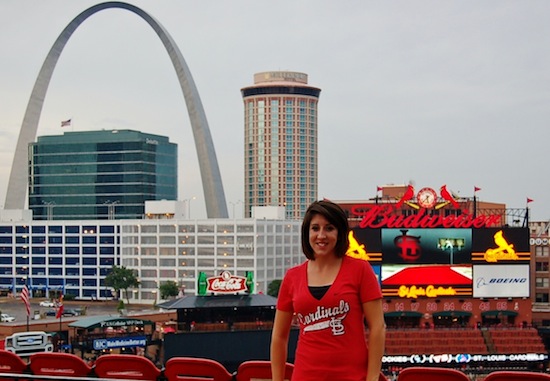
Q & A with Corrine Vitolo

HOME / Q & A with Corrine Vitolo

November 22nd, 2011

We recently asked Corrine Vitolo a few questions regarding her business career, interests, and the business of baseball. Here’s what she had to say:

Q. Tell us about SmartSports – what is the business all about and how did you create it?

In short, we are the physical SAT®. We’ve developed the first quantitative tech system that measures athletic performance; our first market is baseball, football next. Beyond the stopwatch and radar gun, there has been no standardization in sports. We focused on that enormous void — while simultaneously addressing inefficiencies in scouting and player development — and built the solution.

SmartSports emanated largely by chance. I was approached in 2003 by my now partner and co-founder, Larry Scannell, who played for the Red Sox. He had the makings of a great idea; I wanted to pursue something innovative in the space. His background as a player and instructor, coupled with mine in sports management yielded a pretty exciting company…. We’re ready to launch our SmartKage system to 160 locations in the US, have the best partners in technology and baseball, and already have additional products in the pipeline. It is terrific time for us.

Q: Over your career, what position you have held was the most challenging and why?

I’ve always been in the sports business; my early career served Fortune 100 companies business interests in MLB, NFL and Motorsport, largely in strategy and operations. At the time, dealing with multinational companies seemed complex simply by virtue of the size and structure of the organizations. Looking back, it was comparatively simple to what I am doing now.

Any position as CEO is demanding. In SmartSports, it has required an incredible level of stamina. Managing technology development, capital markets, investors, and general organizational matters in parallel necessitates intense focus and dedication. That said, it is absolutely the most gratifying thing I have ever done.

Baseball as a business is somewhat underserved — it’s unique heritage and unmatched legacy as a sport remains somewhat unrealized to its potential. From a business perspective, we are facing substantial shifts in how fans interact with sports. Those of us trying to bridge the gap from past to future are challenged with serving multiple constituencies well, and to a degree, having a correct execution of prediction. America’s pastime is coming quickly into the future… my challenge is to ensure that we have aptly anticipated and correctly equipped that market to engage, and grow.

Q.  Who was a mentor to you in your career and why?

I’ve been blessed with only one: Jerry Welsh. As head of worldwide marketing for American Express, Jerry became best known as the founder of cause-related marketing. His projects always involved something meaningful — not de rigueur in the day: his accomplishments originated from his extraordinary conscience. In my opinion, he is one of the best quiet leaders in the history of US business.

Without ever overtly discussing, he is the one that taught me how to make business work for something larger than the immediate, how to leverage what you had to make the world a better place — in any increment. He saw, he recognized, and he believed in me. Funny, I’ve worked with a lot of very high profile people… I’d say I have been most touched to be considered one of “Jerry’s Kids”…..

Q: What are the most important business lessons you have learned in life?

They have been one and the same: be true to yourself. The rest will follow.

Q: Over your career you have been a consultant, a CEO, a writer and teacher (among other things)  —do you prefer one or two of the those to the others?

No preference, though, my sense is that my current position is the one that will leave the most meaningful fingerprints.

Q: What advice would you have for women aspiring to a career in sports ?

Do it, and go big. Sport is one of the few common denominators in life that transcends any categorical label. Indeed, women are few: all the better reason and opportunity to make your mark.

Q: Talk to us about the Science of Sport — as all training becomes more sophisticated where do you see things going next?

Our entire culture has shifted to science — technology is simply an expression of that. This generation of athletes has exponentially more information available to them — all the better to guide them. Whether through training, conditioning, nutrition, or coaching…. science is the catalyst that is moving all sport forward.

There are a lot of emerging corollaries that are interesting… I think the ones that will matter are the ones that can remain invisible to the user. Smart wearables are easy and scalable, there should be good traction in that. I think some of the most important things I’m seeing are on the predictive realm. For example, after several of our SmartKage sessions, we have enough data to show trend lines… wouldn’t you like to be able to prevent a pitching injury before it happens? We have the science, now it’s simply a matter of implementation.


Q: What do you feel has changed most in the Business of Baseball in the past 10-15 years?

I think it’s the wonderful offshoot of technology: fan interaction. In previous generations, baseball was essentially limited to either a broadcast, or going to a game: it was a finite exposure. If you blinked, you missed. With on-demand information, casual fans have escalated their interests into lifestyles. Via television, phones, devices — all have augmented the fan’s activity level. MLBAM is on top of it for sure, but there is still plenty of space to be addressed. It’s still very much an evolving proposition.

Q: What is your favorite sports moment as a fan?

Ironically, it was completely independent of business. Two very distinct moments in my life, both football related.

I grew up next to the Shula family in Miami. I was a kid, and it wasn’t until I was in college that I realized how extraordinary it was that Don was the one who taught me to throw a football.

More poignantly, when Walter Payton was inducted into the Hall of Fame. He was an amazing athlete, with the biggest heart I’ve ever known. He was a very dear, very missed, friend.

Q: What are your favorite passions outside of work?

Quietly doing good. And very serious driving.

Q: Why would you encourage someone to enter sports as a career?

For the very same reason I was so exited to get involved with TPGF: because you can make a difference. At the end of the day, there are a million businesses you can get involved with — the question is, what matters? Business is only as meaningful as the people it touches. Sport is one of the few places of true commonality between industry and humanity. It may sound dramatic, but it is true. Seldom can business impact people directly: sports can. Any aspect promotes good values: health, personal development, growth, sportsmanship, achievement  — all qualities that positively effect the human condition.  Beyond, there is so much opportunity for growth. There truly are no limits in what one can do.
Welcome Guest Blogger Tara Wellman

HOME / Welcome Guest Blogger Tara Wellman

November 15th, 2011

On this installment of Bob On Baseball, we welcome another fine young writer who is striving to make her mark in sports.  I met Tara Wellman at the U.S. Nationals, one of the biggest drag races in the world, when I was busy handling my “real job” as Team Manager for Tim Wilkerson’s NHRA Funny Car team.  Tara was “dragged” (pun intended) to the race by a friend who was already a fan. Within minutes of meeting her, our mutual love of baseball became the topic and the sheer determination I could see in her eyes impressed me. I immediately knew that this young lady was focused on career success, and nothing I’ve seen or heard from her since has diminished that assessment.

Tara is an aspiring sports journalist whose first love is baseball (more specifically, St. Louis Cardinals’ baseball!)  She completed her undergrad degree at St. Ambrose University in Davenport, Iowa in May 2010, double-majoring in Journalism and Radio/TV Production. Since then, she’s gone on to host a local television show, direct local sports broadcasts, write for a new online sports network (AerysSports.com), host her own blog about her other sports love – figure skating – and interview past, present, and future champions along the way.

She describes herself as a dedicated sports fan, a passionate story teller, and an undeniable dreamer. Tara has big plans for her career, but they all center on finding great stories and telling them with a creative twist – the kind of stories you just can’t put down. When not working or writing, she enjoys watching Sports Center, playing the piano or guitar, and relaxing at Starbucks.

Enjoy Tara’s work, and remember her name. She will not stop short of success.

Bob Wilber

~~~~~~~~~~~~~~~~~

“If you’re not going to play to win, why play?”

That was my grandpa’s motto for anything competitive. Don’t just muddle through, strive to be the best. He taught my mom well – she was the star of her high school basketball team, an excellent softball player, and later, a high school basketball coach. (She never backed down at Candy Land, either. Or Skipbo. Or Pictionary. …you get the idea. If I was going to win, I had to earn it.)

In my family, you play to win. Not because winning is everything, but challenging yourself to achieve something great is.

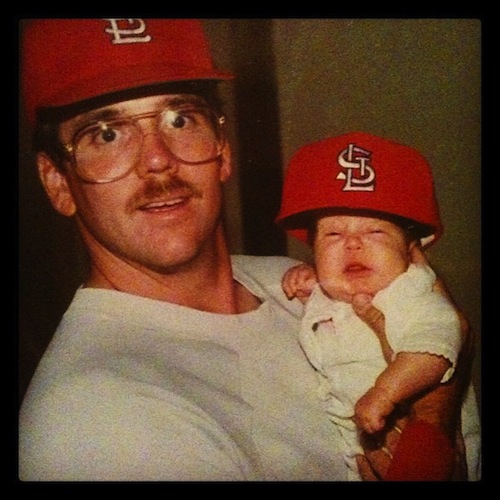
A very young Cardinal fan, and her proud father

My dad, then, introduced me to other sports. A native St. Louisian, his priorities were always the home team, and topping that list, the Cardinals. He was a fan when there wasn’t a lot of good baseball played at Busch. But he believed in them, cheered them on, and loved them through it all.

Similarly, I’m never short on support from the home front. Not because I never fail, but because they believe one day I will succeed.

Like any kid, my life goals changed as often – and as dramatically – as the seasons in my hometown’s mountain west climate. Singer, artist, detective, Olympian, president, and ultimately, writer. But that last one didn’t come until much later – my junior year in college.

I wasn’t much for making decisions. I wanted to do too many things to pick just one! I’d settle on something like photography, only to be discouraged by all the things I’d have to leave out to make that work.

To add to the confusion, teachers and friends had a whole different idea for my life – I should be a teacher, like my mom. (Not because I’d actually be any good at it, mind you, but simply because, well, like mother-like daughter, right?)

Whatever I chose to do, I wanted two things – to love what I do so much that it hardly felt like work at all, and to be the best at it … or at least try. If I’m not playing to win, why play?

The journey to my current post as a sports journalist is long, winding, and not entirely interesting for the average reader, so I’ll spare you the details. To sum it up, my parents – who had never pushed one direction or the other – offered a new idea: Do what I already love, no matter what others might say. And, of course, strive to do it as well as I possibly could.

So, after a dramatic program shift followed by two years of overwhelming myself (in a good way) with the activities of sports writing, radio announcing, and television reporting, I was off to the real world. Little did I know that all those things people say about women in sports would be more accurate than I was willing to admit.

It’s tough being a girl who likes baseball more than beauty products. Convincing hard-core sports fans that I know what I’m talking about – and can write about it just as well as their favorite male writer! – is a constant battle. And good luck being chosen for a sports job over an equally qualified “sports guy.”

It’s tough.

But my grandpa taught me well.

I worked hard, took some risks, and gave up once-necessary sleep to make it work. And I spent this baseball season doing something many people never considered possible – writing for an online sports network about my beloved St. Louis Cardinals. Yes, you saw that right. A girl who grew up learning about baseball from her dad (who, by the way, always told her she could do anything the boys could do!) documented what turned out to be an historic whirlwind of a season that ended in the best way possible … World Champs, anyone?

A loyal Cardinal fan for life!

Just in case I didn’t learn my lesson on stick-to-it-ive-ness from my deeply competitive and supportive family, the 2011 Cardinals were a superb reminder.

The season (in which they were favored at the start) wobbled on a tight rope-thin edge for months as expert after expert calculated the reasons this team would never make it all the way. In late August, when things had taken the worst turn yet, the 10.5 games separating the Redbirds from the playoffs nearly proved those experts right.

Thus began the greatest comeback in major league history, thanks to a team that, as announcer Joe Buck would eventually say, just wouldn’t go away.

They played to win, and they would settle for nothing less than their utmost effort to do just that.

They could never make the playoffs. But they did.

They could never beat baseball’s golden-child Phillies. But they did.

They could never take on their “beastly” league rivals – the ones who had run away with the division – to claim the National League pennant. But, again, they did.

And again, and again, and again.

Even when they found themselves a strike away from losing game six and watching the Texas Rangers celebrate their first ever World Series win on the Cardinals’ home turf, they battled back. Not once, but twice. And in the most appropriate way possible, the never-say-die “Cardiac Cardinals” powered their way around the “experts’” predictions yet again and forced a game seven.

Oh, and, they won that, too.

In the eyes of their adoring fans, there was never any doubt, and never a better moment.

Some may say, “It’s just baseball,” but look what this team’s resilience proved: Cliché as it might sound, don’t ever, ever give up.

It’s not about what anyone else says. It’s all about what you do.

I learned how to compete at an early age. I learned to live passionately as I developed what I loved. I accepted the challenge of a career that would take plenty of work, knowing that, no matter the “experts” counting me out, it’s possible to prove them all wrong. And that, no matter what, there were those who would always have my back – they would always be my biggest fans.

I love what I do. Telling a story that taps into an audience’s emotion isn’t just a job, it’s a passion. And while I’m not there yet, I’m striving to be the best. Not because I need accolades to quantify my success, but because, well, it’s what I do.

I play to win.