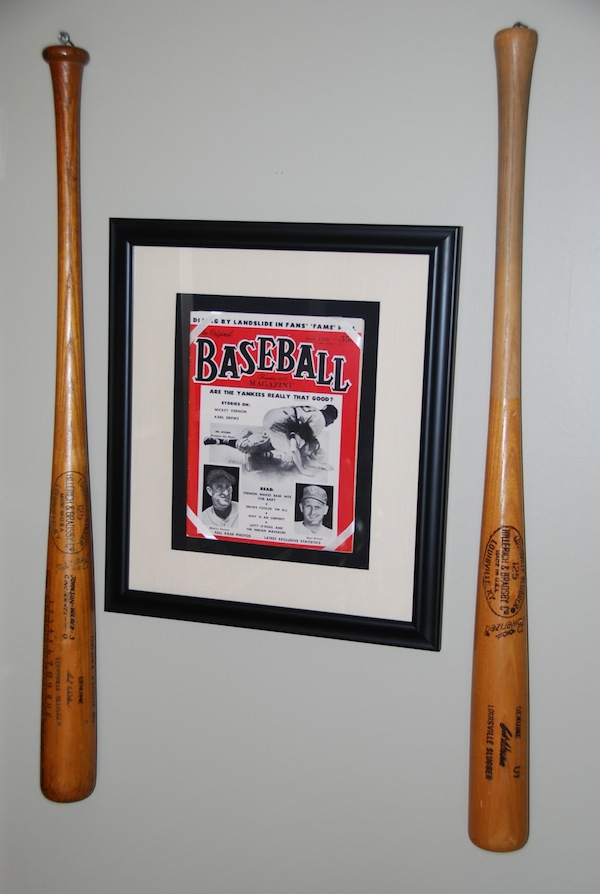
Hanging on the wall, here in my home office, are two baseball bats. One is somewhat famous, the other nearly anonymous. As you can see, they straddle a framed copy of Baseball Magazine, from 1953, and the catcher in the cover photo is my father.
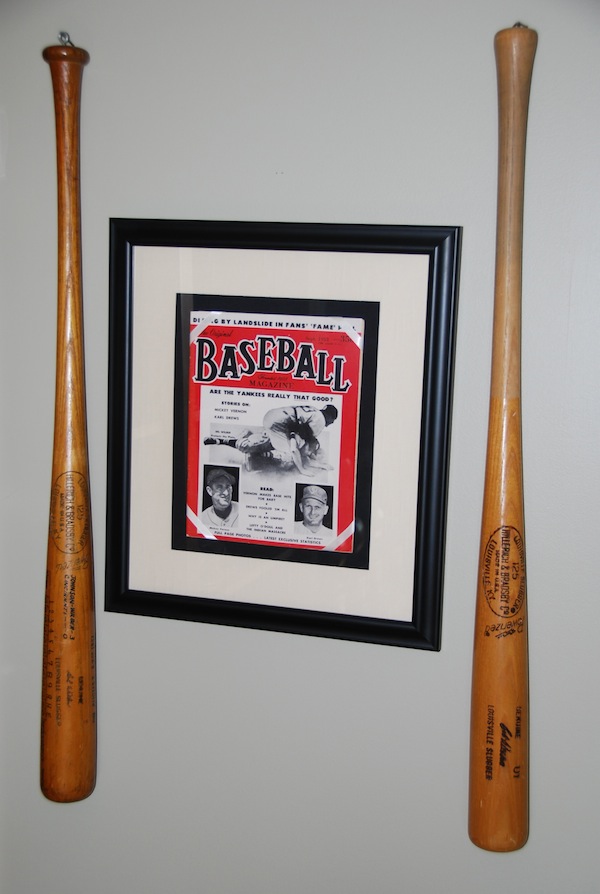
His bat hangs to the left, but it’s not just any Louisville Slugger and it’s not just any Del Wilber autographed model. This very bat is the one he used on August 27, 1951 at Shibe Park in Philadelphia, while playing against the Cincinnati Reds. On that very night, Big Del achieved something so outstanding we have named this charity in reference to his accomplishment. He came to bat three times, took three swings, and hit three solo home runs, accounting for all of the scoring in the Phillies’ 3-0 win over the Reds. It’s a special bat.
Big Del had his Louisville Slugger designed to fit his needs, and since the bat was specifically cut and weighted to his exact preference, Hillerich & Bradsby designated it as the W15 model.
The bat on the right is one of mine, and one of only two Bob Wilber autographed bats left on the planet. It’s a U1 model, originally designed for some other player, but at some point in my young career I picked one up and liked the feel of it. I therefore, for better or for worse, stuck with the U1 until my fleeting minor league career was over. I blame the U1.
It has a tapered handle, with no knob. That sort of style is usually the favorite of the choke-up slap hitter, but I took a full swing like a power hitter. My theory, passed along to me by many head-shaking coaches, was “Swing as hard as you can, in case you actually hit the ball.”
It has a relatively thick handle as well, and that again worked at cross-purposes with my intent. The thicker the handle, the slower you are able to get the bat head going. A thin handle allows the hands (and the bat head) to rotate more quickly, but a thin handle on a wood bat also creates one other byproduct. If you don’t hit the ball on the big part of the barrel, thin handles sting a lot more.
Since I did not have the quickest hands to begin with, I tended to get jammed every now and then (if, by “every now and then” you mean at least once a game) so the whole “handful of bees” thing was not high on my wish list. The thicker handle on the U1 protected me from the stings, but it probably slowed my bat down even a little further.
So why did I pick the U1 and continue to use it until no one would pay me to play anymore? Was it because it improved my chances for getting hits? Did it maximize my bat speed? Was it the right bat for me? No, no, and no. It just felt good. Back in the day, well before video training and high-tech coaching, two topics were consistently repeated with young players, and the advice was the same in both cases. For your stance, pick something that feels good. For your bat, pick something that feels good. Great stuff. Thanks for thinking outside the box, coaches!
Now, of course, we can visualize and test various stances, to improve any hitter’s chances for success. You still don’t want to be up there totally uncomfortable, but any good hitting coach can spot flaws that are going to make an improbable action (hitting a baseball) closer to impossible. Coaches work with players from Little League to the Major Leagues, finding flaws in their swings and stances. Good coaches make hitters better.
In terms of bats, little progress has really been made in terms of tailoring a bat to fit a swing, but I think coaches and players are a little more savvy when it comes to design. Back in the 1970s, when I was swinging my beloved U1, it just felt good.
The biggest problem we have now, in professional baseball, is the pervasive use of metal bats at every other level of the game. When my pro days were over and I began playing semi-pro ball for the Sauget Wizards, the first thing I noticed was how much faster my bat was, and how much more power I had, swinging an aluminum bat. I was one of the lone hold-outs to use wood in college, while everyone else was making the transition to metal, so my Wizards days marked the first time I’d been brought over and seduced by “the dark side” with a metal bat. The handle could be thin, the barrel could be huge, and the thing could still weigh no more than 31 ounces. Wooden bats couldn’t be made that way, because there wasn’t enough strength in the handle to manage the torque and whip of a big heavy barrel.
Now, we see bats shattering and breaking every night in the big leagues, as an entire generation of hitters have come to think a thin handle and thick barrel is the only way to go. After all, the metal bats they used as kids were all like that! Once in the pros, they still want that feel in a wooden bat, and what they get is a toothpick, ready to snap.
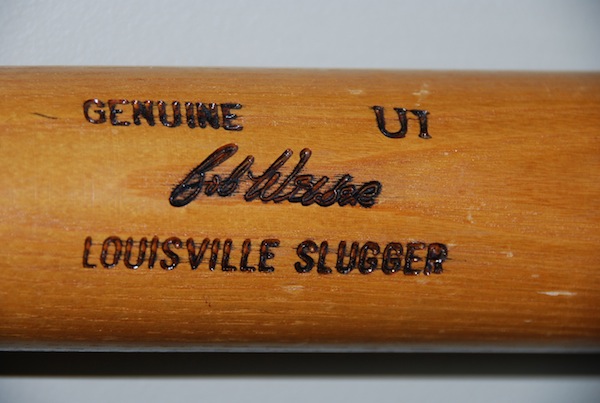 My U1 on the wall does have one thing going for it, and that’s why it’s there. It has my autograph burned into the wood, and that was something I dreamed about since birth. We all grew up swinging Mickey Mantle bats, or Willie McCovey bats, or some other hero’s model. We knew the most popular model designations, too. The K55 was a pretty run-of-the-mill bat, with a moderate handle and good weight distribution. The R43 had a slightly thinner handle and a little more top-end whip. The S2 was for the brave souls, with a very small handle and a solid propensity to sting you. And then there was the U1… I have to tell you, I can take it down off the wall right now and it STILL feels good in my hands. It wasn’t much of a tool for hitting, but it sure feels good.
Sure enough, there above my scrawled name (Hillerich & Bradsby has you sign your name a number of times when you get a bat contract, so that they can pick the one that can best be used in the branding process) there’s the designation U1.
That’s another evolutionary part of the Louisville Slugger’s development. In my dad’s day, and in my childhood, the model number was always stamped on the bottom of the knob. By the time I got to the minor leagues, they’d moved it to just above the autograph. So don’t let anyone sell you an “authentic” Babe Ruth bat if the R43 is right by his autograph.
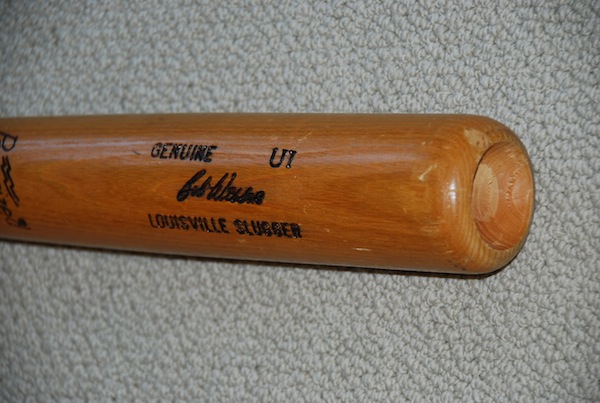 My U1 did have one nice little bit of late 70s technology included, and it’s something many players are still requesting to this day. It has a “cupped end” design, where a bit of the top of the barrel has been scooped out. As with my infatuation with the U1 itself, because it felt good, my interest in the cupped end also started with the fact I thought it looked cool. Then, I heard the theory behind it and I never swung a regular bat again.
Why the cupped end? Because heavier wood is denser wood and denser wood is harder wood. This way, they could take a 33 oz. bat, made with harder wood, and just scoop an ounce and a half out of the end. Lighter bat, harder wood.
So there you have it. The handle’s too thick, there’s no knob for leverage, and as a minor leaguer the best I ever did with the U1 was to get my average up to around .275 for a brief while, playing for Paintsville in the Appalachian League.
But it sure did feel good!